Short answer
A needle holder (called portegü in Turkish, from the French porte-aiguille) is the surgical hand instrument used to grip the suture needle and drive it through tissue. Its short, strong jaws hold the needle without slipping, and the ratchet between the rings locks the jaws closed. The physician grips the needle, drives it through the tissue with a turn of the wrist and picks it up again on the other side.
The most common types are the Mayo-Hegar, the fine-jawed Crile-Wood, the ringless Mathieu with a palm lock, the spring-loaded Castroviejo for microsurgery and the Olsen-Hegar with scissors behind the jaws. The choice follows the size of the needle, the fineness of the suture and the depth of the area being closed. The Demir Med catalogue lists the Needle Holder and the Sapphire Blade Holder used in hair transplants; both are sold per piece, by quotation.
What is a needle holder and what does it do?
The needle holder is the basic suturing instrument. It has one job: to hold the curved suture needle firmly and let the physician drive it through tissue at the angle they want. So the answer to what a needle holder is used for is short: it holds the needle, not the tissue.
It is often confused with two other instruments:
| Instrument | What it holds | Jaws | Lock |
|---|---|---|---|
| Needle holder | The suture needle | Short, strong, finely serrated | Yes (a different type on Mathieu and Castroviejo) |
| Forceps | Tissue, swabs, grafts | Long, fine, toothed or smooth | No; works by finger pressure |
| Clamp (haemostat) | Vessels, tissue | Long, transversely serrated | Yes |
Clamps and needle holders look alike from the outside because both have rings and a ratchet. The difference is in the jaws: a clamp's jaws are long and serrated to crush and close a vessel; a needle holder's jaws are short and thick, stiff enough to hold the needle without letting it turn. Holding a needle with a clamp makes the needle slip and damages the clamp's jaws. For the general classification of surgical instruments see the surgical instrument names guide.
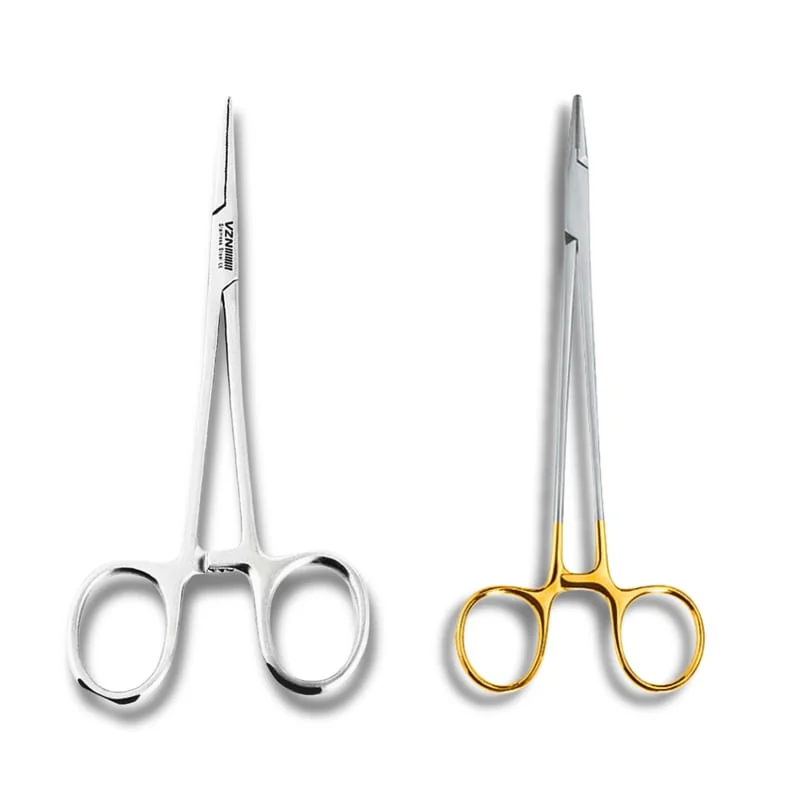
Parts of a needle holder
| Part | Function | What to check |
|---|---|---|
| Jaws | Grip the needle | Both faces meet exactly when closed; serrations not worn |
| Joint (box lock) | Joins the two arms | No play and no stiffness; opens and closes smoothly |
| Shanks | Carry the force to the jaws | No bending or cracks |
| Ratchet | Keeps the jaws closed | Does not spring open by itself, even on the first tooth |
| Rings | Where the fingers go | No burrs or deformation |
The shorter and thicker the jaws, the stronger the grip; the longer the shanks, the easier it is to reach deep areas. The ratchet usually has three teeth: the first tooth is used for a light hold and the first or second for a standard needle grip. Closing to the third tooth can bend a fine needle.
Types of needle holders
Needle holder types are named after the surgeons who designed them. The ones met most often in clinics:
| Model | Build | Typical length | Use |
|---|---|---|---|
| Mayo-Hegar | Wide, strong jaws, rings, ratchet | 14–20 cm | General surgery, heavier needles and sutures; the standard of clinic sets |
| Crile-Wood | Fine jaws, rings, ratchet | 15–18 cm | Medium-fine sutures in plastic and general surgery |
| Derf | Short and fine | Around 12 cm | Skin closure, small areas, paediatric use |
| Mathieu | No rings, spring, palm lock | 14–17 cm | Dentistry, minor surgery; opens and closes with one hand |
| Castroviejo | Spring-loaded, held like a pen, fine jaws | 14–18 cm | Microsurgery, ophthalmic and fine plastic surgery sutures |
| Olsen-Hegar | Scissors behind the jaws | 14–16 cm | Teams that want to place and cut the suture with one instrument |
The Mayo-Hegar needle holder is the model found most often in clinic instrument sets; it is the general-purpose needle holder of outpatient clinics, emergency departments and minor surgery rooms. Plastic surgery and dermatology teams working with fine sutures usually prefer finer-jawed models. Which model is used for which procedure is the physician's decision.
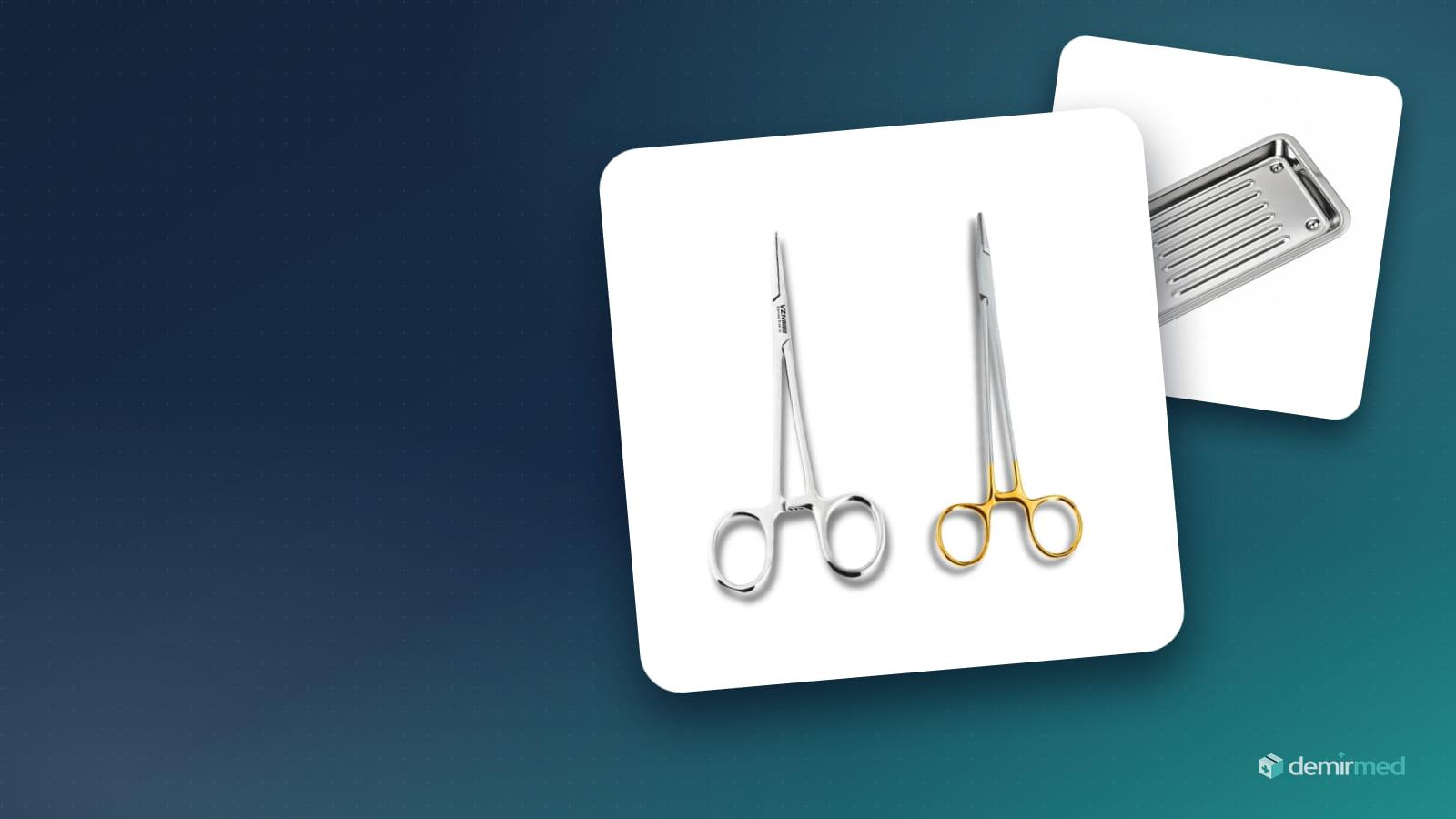
Needle holder types
Mayo-Hegar · Crile-Wood · Castroviejo
Jaw types: serrated, smooth and tungsten carbide
The jaw surface decides how firmly the needle stays in place:
- Cross-serrated jaws: The most common type; they grip the needle so that it does not turn.
- Fine-serrated or smooth jaws: Preferred with fine needles and fine sutures so as not to damage the thread; common on microsurgical instruments.
- Tungsten carbide (TC) inserts: A hard insert is fixed to the jaw faces; it resists wear better and holds the needle more steadily. Many makers mark TC instruments with gold-coloured rings.
For the Needle Holder in the catalogue, the length, jaw type and material are stated in writing on the quotation; just state the length and jaw type you want in your quote request.
How to choose the length
Two questions decide the length: how large is the needle, and how deep is the closure?
| Situation | General tendency |
|---|---|
| Superficial skin closure, small area | 12–14 cm, fine jaws |
| Standard wound closure, outpatient and emergency | 14–16 cm, Mayo-Hegar |
| Deep area, heavy needle and suture | 18–20 cm and longer, strong jaws |
| Fine suture (5-0, 6-0 and finer) | Fine jaws, Castroviejo if needed |
| Heavy suture (2-0, 0 and heavier) | Wide, strong Mayo-Hegar |
This table is general guidance; the choice of instrument and suture is the physician's decision. What suture sizes mean and which size is used where is explained in the surgical suture types and sizes guide.
How to hold a needle holder and load the needle
The classic answer to how to hold a needle holder is the ring grip: the thumb goes into one ring and the ring finger into the other; the index finger rests on the shank near the joint and steers the instrument. Some physicians hold the instrument in the palm without putting their fingers in the rings to work faster. Mathieu and Castroviejo types are held differently: the Mathieu is squeezed in the palm, the Castroviejo is held like a pen.
The needle is loaded according to these rules:
- Use the tip of the jaws: Grip the needle with the part of the jaws near the tip; a needle pushed deep into the jaws can bend.
- Hold the back half of the needle: The needle is usually gripped between its back third and its middle third; holding it near the point blunts it, and holding it at the swage where the thread is attached can break it.
- Grip at a right angle: Place the needle at a right angle to the jaws so that when the wrist turns, the needle passes through the tissue along its own curve.
- Close the ratchet lightly: The first tooth is enough for most needles; closing harder can straighten the needle.
- Take the needle with the instrument, not the hand: The needle coming out of the tissue is picked up with the needle holder or forceps; the needle point is never held with the fingers.
Used needles and scalpel blades go straight into the sharps container when the procedure ends.
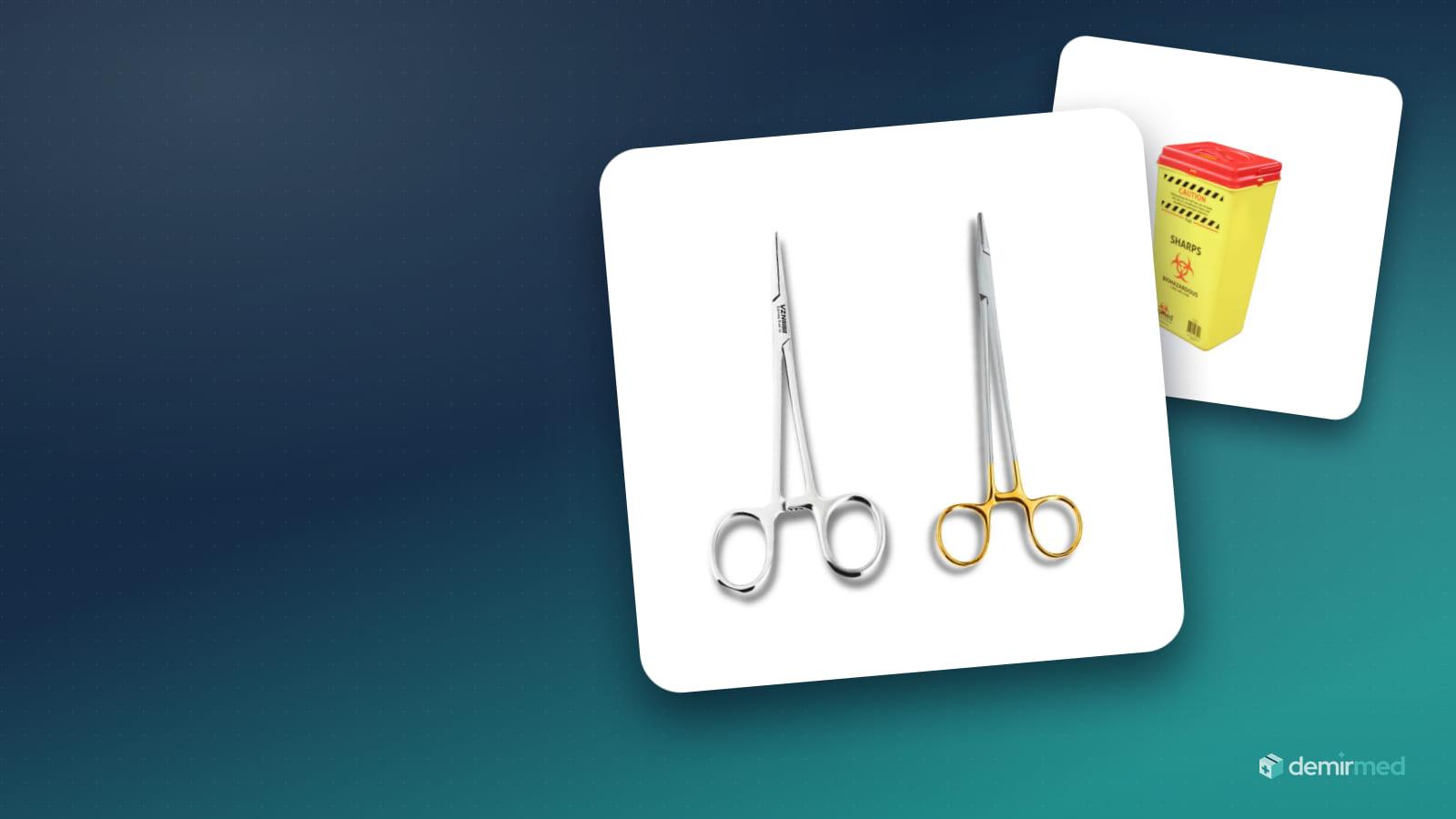
Loading the needle
Tip of the jaws, back half of the needle, right angle
Suture set: needle holder, scissors and suture together
A suture set is the instruments and consumables needed for suturing, prepared together. A typical suture set in outpatient clinics, emergency departments and minor surgery rooms contains:
| Item | Function | In the catalogue |
|---|---|---|
| Needle holder | Holds the needle | Needle Holder |
| Surgical scissors | Cut suture and tissue | Surgical Scissors |
| Scalpel handle and blade | Make the incision, trim edges | Scalpel Handle |
| Suture | Holds the tissue together | Monocryl 4-0 and other sizes |
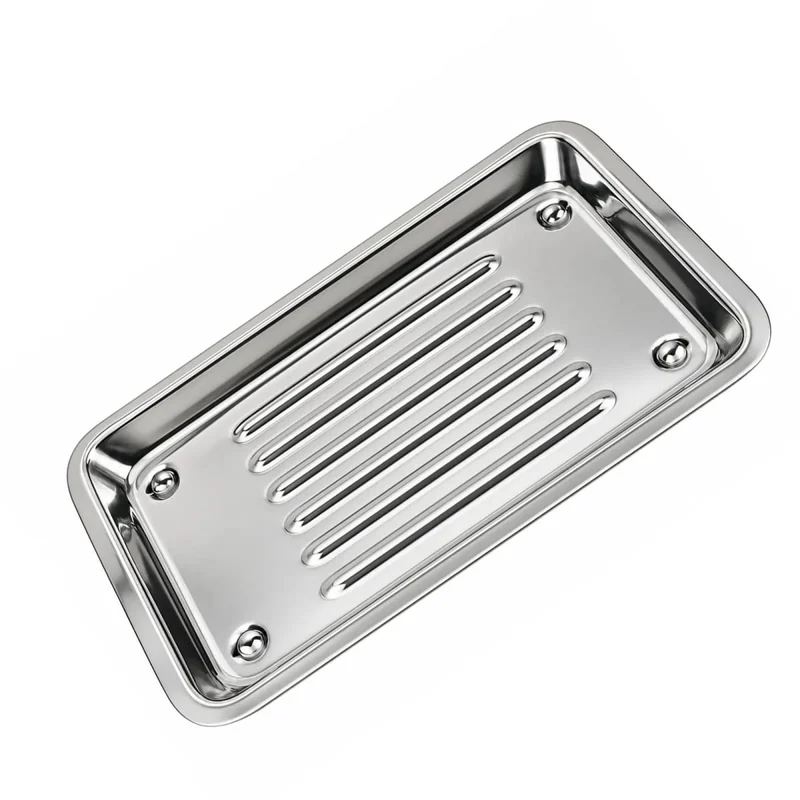
| Instrument tray | Keeps the instruments in order on the sterile field | Stainless steel tray |
| Sterile drape, swabs, gloves | Sterile field, bleeding control, hand hygiene | Sterile 2-piece drape set |
A forceps is also used to hold tissue. The facility's protocol and the physician decide which items go into the set for which procedure. For scalpel blade numbers see the scalpel blade numbers and scalpel handle guide.
Needle holders in hair transplants: the sapphire blade holder
In hair transplantation the word portegü is also used for channel-opening instruments. When channels are opened in the recipient area, the sapphire blade is fixed in a holder; one of these holders is a needle-holder-shaped instrument that grips the blade with its jaws.
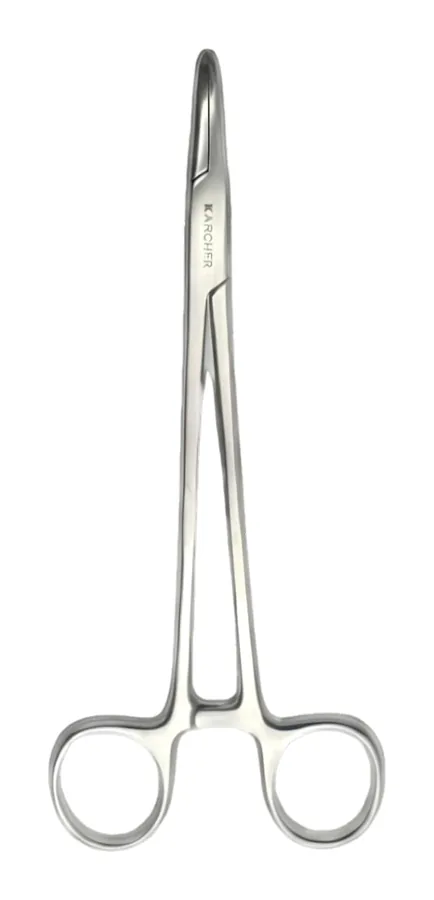
The catalogue's Sapphire Blade Holder holds the sapphire blade between its jaws; the length of blade left outside is set according to the physician's channel plan. The blade is not included and is ordered separately from the sapphire blade category. The Blade Handle, with a screw clamp and depth adjustment, can be used for the same job; which one is chosen depends on the physician's habit and technique.
| Sapphire blade holder | Blade Handle | |
|---|---|---|
| How it holds the blade | Grips it with its jaws | With a screw clamp |
| Depth | Set by the length of blade left out of the jaws | Set and locked with a depth stop |
| Blades it takes | Confirmed on the quotation for the blade form | Straight-shaft sapphire blades and slit blades |
For all the instruments of the hair transplant room see the instruments used in hair transplantation guide.
Cleaning, sterilisation and care
The needle holder is a reusable instrument; its life depends on cleaning and care.
- Pre-clean at once: After use, keep the instrument moist or put it in a pre-cleaning solution before blood and tissue dry on it.
- Wash it open: The joint and serrations can only be cleaned with the instrument open; an instrument left locked holds residue.
- Dry and inspect: Check jaw alignment, the ratchet and the joint at every cycle. If the ratchet springs open on the first tooth or the jaw faces no longer meet, take the instrument out for service.
- Sterilisation: Follow the clinic's instrument reprocessing procedure and the material stated on the quotation; send the instrument to sterilisation open or on the first tooth of the ratchet.
- Storage: Storing instruments fully locked for long periods strains the ratchet and joint; store them open or on the first tooth.
For sterilisation equipment and the instrument flow see the sterilisation equipment page.
Needle holder purchasing checklist
- Suture sizes and needle sizes to be used
- Model: Mayo-Hegar, Crile-Wood, Mathieu, Castroviejo or Olsen-Hegar
- Length (cm) and jaw type: serrated, fine-serrated, tungsten carbide
- Material and sterilisation instructions
- How many: rooms working at the same time and the length of the sterilisation cycle
- The rest of the set: surgical scissors, scalpel handle, tray, sutures
- For hair transplants: sapphire blade holder or Blade Handle
- CE and UTS documents: shared once verified
Needle holder quotations from Demir Med
Demir Med sells to clinics and healthcare facilities by quotation. The Needle Holder, Surgical Scissors, Scalpel Handle and stainless steel tray are in the Surgical Instruments category; sutures are in the Surgical Consumables category. Hair transplant teams can add the Sapphire Blade Holder and sapphire blades to the same list. Send your needs with the length and jaw type through the quote request page; a written quotation follows within 1 business day.