Short answer
A surgical suture is defined by three properties: its thickness, whether it is absorbed in tissue and how its fibre is built. Thickness is given by the suture size: the more zeros, the thinner the thread, so 3-0 is thicker than 4-0 and 4-0 thicker than 5-0. An absorbable suture dissolves in tissue over time; a non-absorbable suture is removed or stays in place. A monofilament thread is a single fibre, a braided thread is made of many fibres woven together. Which suture is chosen depends on the site, the tissue and the procedure; the choice is the physician's. The Demir Med catalogue lists the absorbable monofilament sutures Monocryl 3-0, Monocryl 4-0 and Monocryl 5-0, and the suturing instruments needle holder and surgical scissors.
What do suture sizes mean?
The suture size gives the diameter of the thread. In the common scale (USP) thin threads are written with zeros: 2-0 is read "two-oh", 3-0 "three-oh", and the more zeros, the thinner the thread. Boxes also carry the metric equivalent (Ph. Eur.) next to this number.
| Suture size | Order of thickness | Common example of use | Product in the catalogue |
|---|---|---|---|
| 2-0 | Thicker | Tissues that carry more tension | — |
| 3-0 | Thick | Subcutaneous closure on trunk and limbs, scalp | Monocryl 3-0 |
| 4-0 | Medium | Subcutaneous closure, soft tissue approximation | Monocryl 4-0 |
| 5-0 | Thin | Delicate areas such as the face and thin skin | Monocryl 5-0 |
| 6-0 | Thinner | Delicate closure in very thin skin | — |
The examples in the table show general habit, not a rule. A thin thread leaves less of a mark but carries less tension; a thick thread is strong but takes up more room in tissue. The physician strikes the balance.
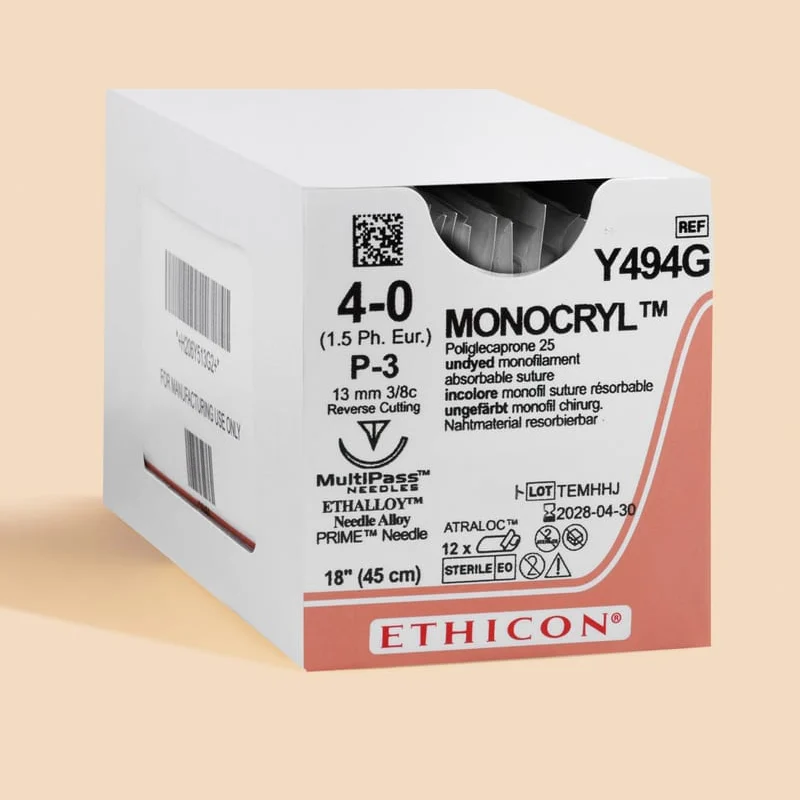
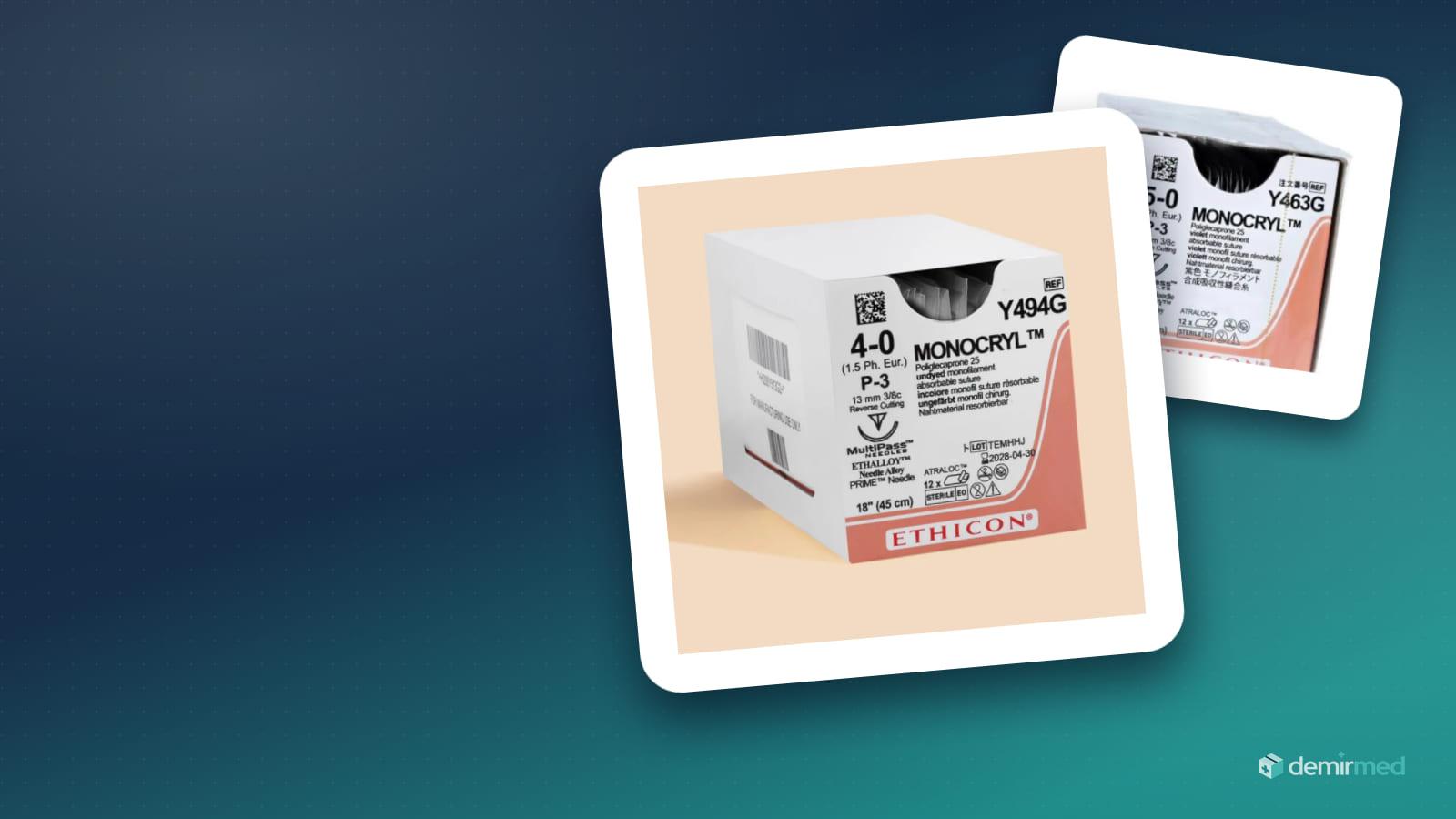
Suture sizes
More zeros, thinner thread
Absorbable or non-absorbable? Types of suture
Sutures are first divided by how they behave in tissue.
| Type | What happens in tissue | Are the stitches removed? | Typical use |
|---|---|---|---|
| Absorbable suture | Dissolves and is absorbed over time | Usually not | Subcutaneous closure, deep layers, soft tissue |
| Non-absorbable suture | Stays in tissue | When used on skin, removed on the day the physician sets | Skin closure, tissues that need lasting support |
An absorbable suture is preferred in the layers that stay under the skin, because the patient does not have to come back to have stitches removed. The absorption time and how long the thread keeps its strength depend on the material; these are given in the manufacturer's instructions for use. The Monocryl in the catalogue is an absorbable suture. Decisions about knots left on the skin and about wound follow-up are the physician's.
Monofilament or braided?
The second distinction is how the thread is built.
- Monofilament (single fibre): the surface is smooth and passes evenly through tissue. Tying the knot needs more care, because a smooth thread tends to slip.
- Braided (multifilament): made by weaving many fine fibres; it is soft, handles easily and holds a knot well. Because of the spaces between the fibres, the physician decides in which tissue it is used.
The Monocryl in the catalogue is a monofilament; its product pages name subcutaneous (subcuticular) closure and soft tissue approximation as common uses.
Suture needle types: cutting, reverse cutting, round
A suture mostly comes with its needle, attached to it at the factory. The same thread thickness is made with different needles, so the size alone is not enough when ordering.
| Needle property | Options | What it means |
|---|---|---|
| Point | Round, cutting, reverse cutting | A round needle spreads tissue; cutting needles have sharp edges to pass through tough tissue such as skin |
| Curvature | 3/8 circle, 1/2 circle, straight | How much of a circle the arc of the needle is; in a narrow field more curvature makes the turn easier |
| Length | In millimetres | The length of the needle; a short needle is used in thin skin |
On a reverse cutting needle the sharp edge is on the outside of the curve; it is a needle type often used for skin closure. Which needle is chosen is again the physician's preference; in a quote request it is enough to state the needle type or the product code you are used to.
How is a suture box label read?
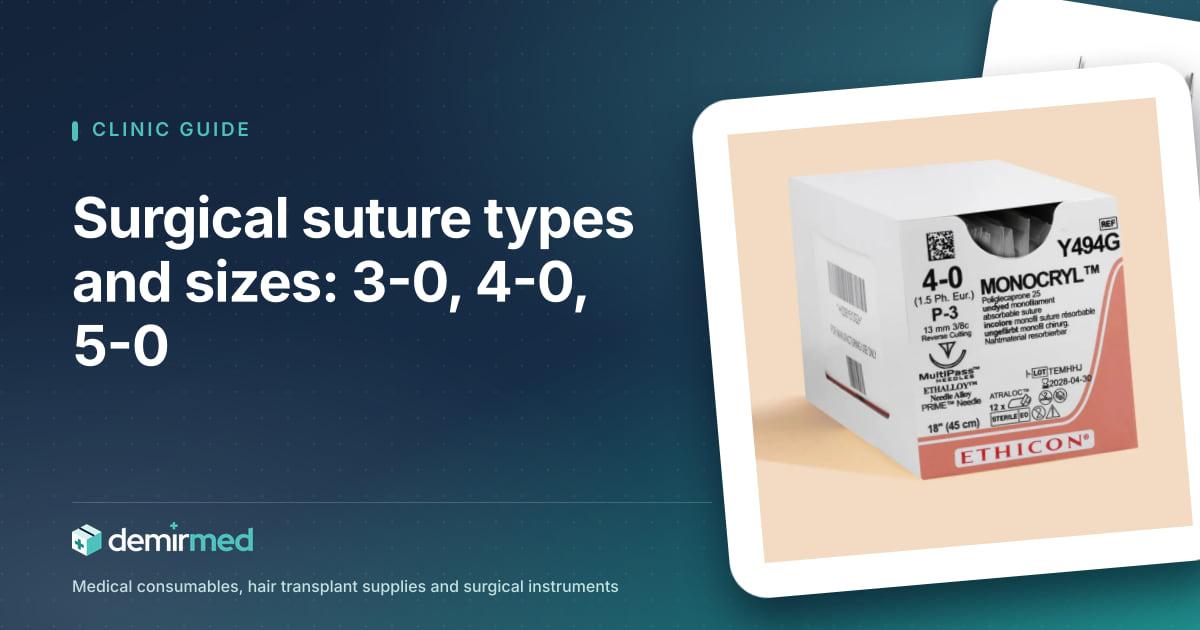
The front of the box carries everything that defines the thread. The box in the photograph below is an example; the code of the product sent to you is stated in the quotation.
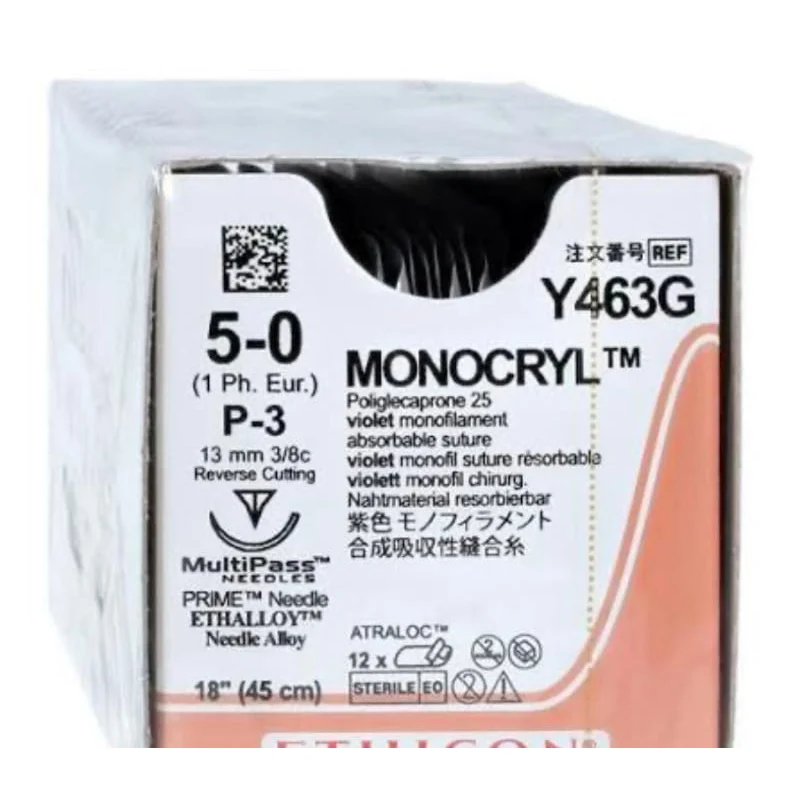
| Information on the label | Example | Meaning |
|---|---|---|
| Size | 5-0 (1 Ph. Eur.) | Thread thickness; the figure in brackets is the metric equivalent |
| Material and structure | Poliglecaprone 25, monofilament | The raw material and fibre structure of the thread |
| Absorption | Absorbable suture | The suture is absorbable |
| Colour | Violet or undyed | Dyed (violet) or undyed thread |
| Needle | P-3, 13 mm, 3/8c, reverse cutting | Needle code, length, curvature and point |
| Thread length | 18" (45 cm) | The length of thread in one pack |
| Quantity | 12 x | Number of packs in the box |
| Sterile, lot, expiry | STERILE, LOT, hourglass symbol | Sterilisation method, batch number and date |
| Product code (REF) | Y463G | The code used to reorder the same product |
Quantity per box, needle type and thread length differ by product code. If there is a code you use regularly, write it in the quote request; that is the shortest way to receive the same product.
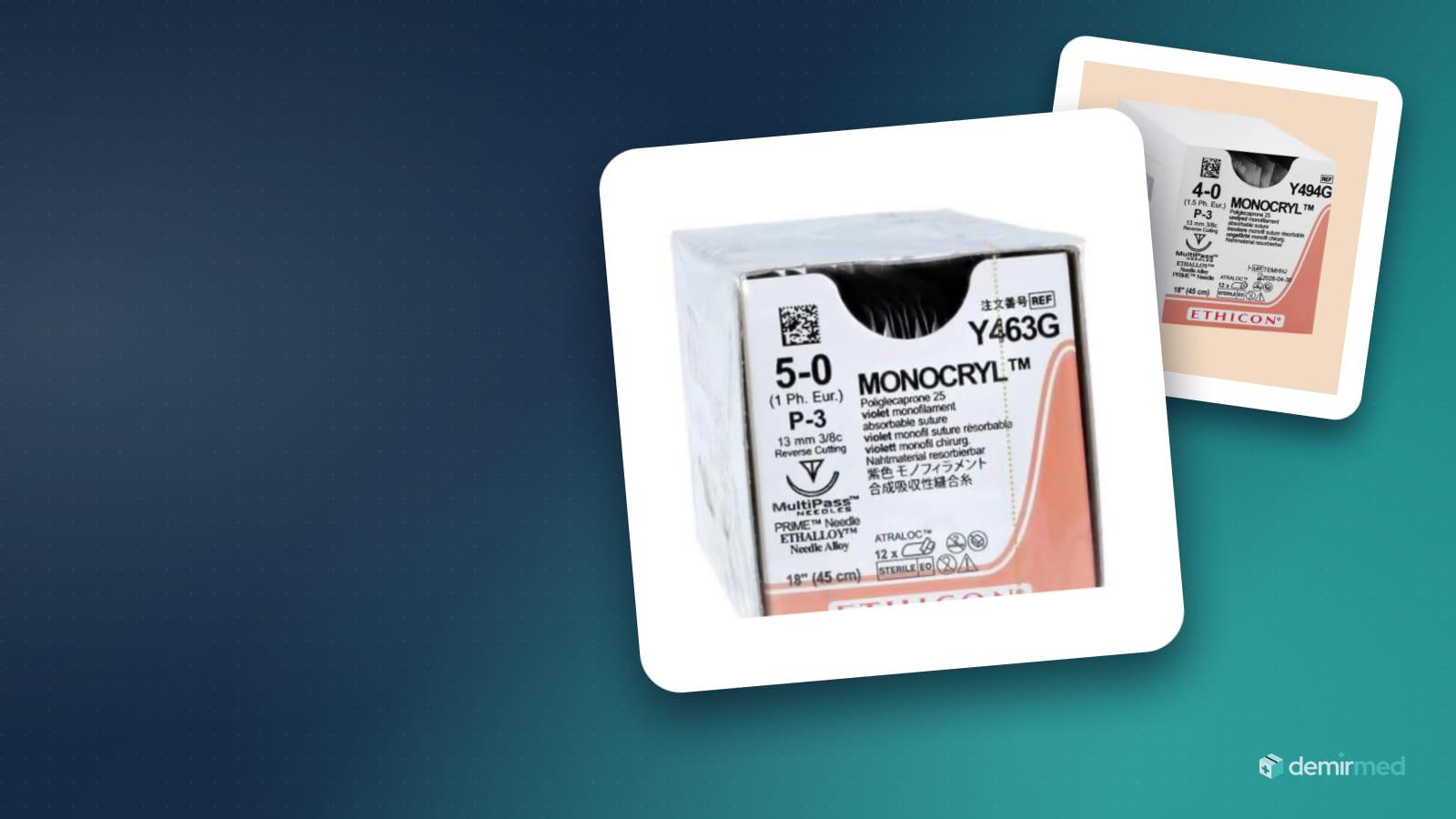
Box label
Size, needle and thread length on the label
Which instruments are needed for suturing?
A suture is not used alone; a small instrument set is needed.
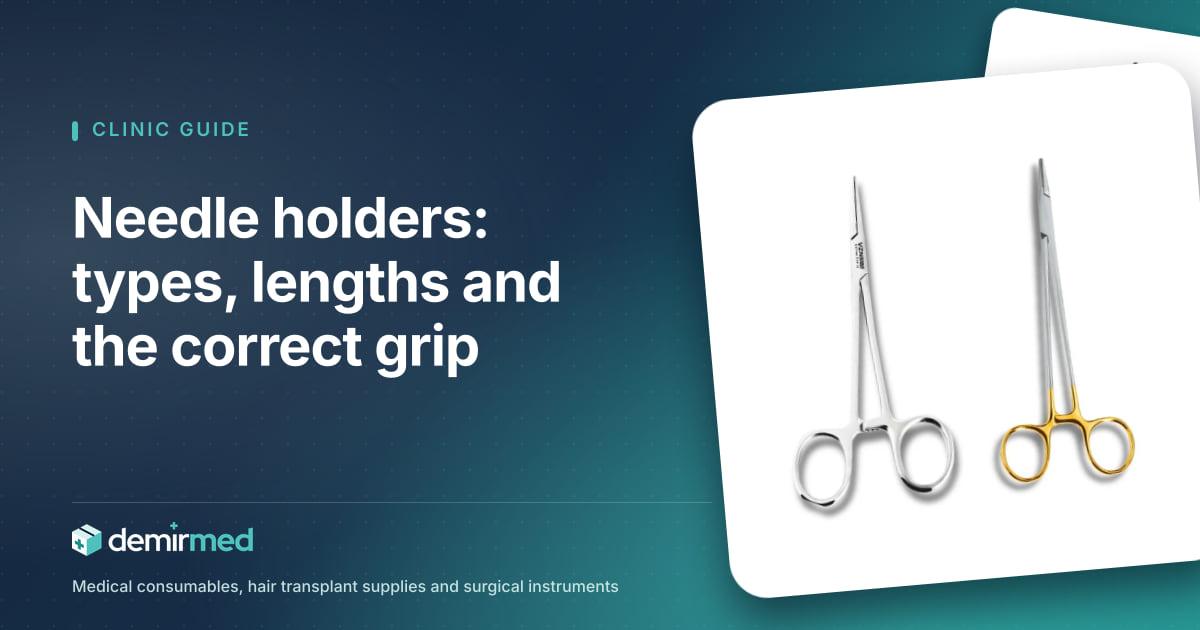
- Needle holder: grips the suture needle and guides it through tissue. The needle holder in the catalogue is reusable; length and jaw type are stated in the quote request.
- Surgical scissors: cut the thread. The surgical scissors are stainless steel and autoclavable; sharp or blunt tips are stated in the quote request.
- Scalpel: for the incision, a scalpel blade and a scalpel handle; for choosing a blade see scalpel blade numbers.
- Sterile consumables: sterile surgical gloves, a sterile surgical drape and gauze swabs.
- Waste: the used suture needle goes into the sharps container.
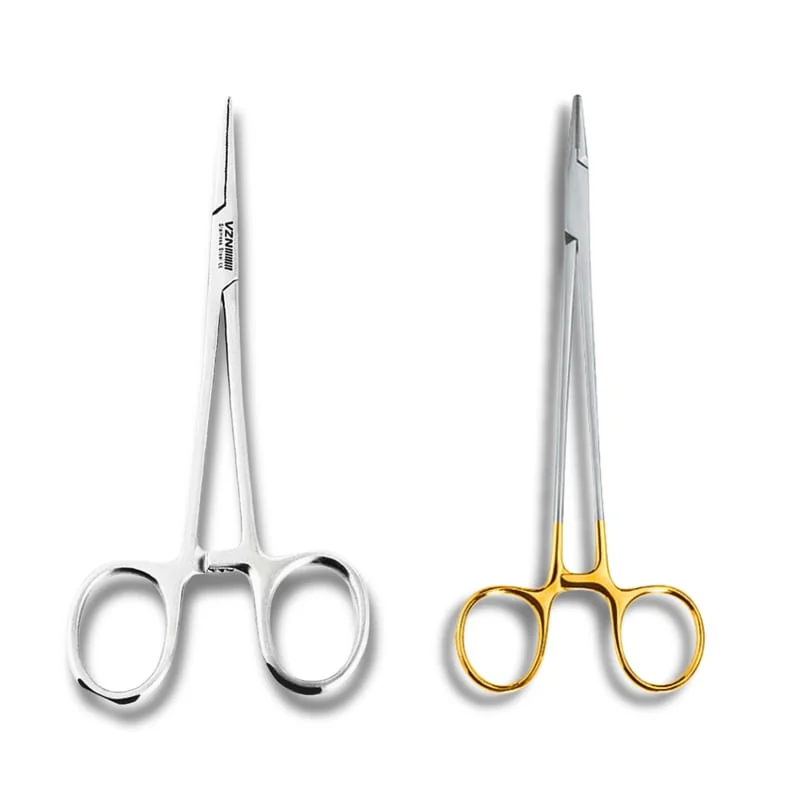
For an overview of instrument names and their jobs see surgical instrument names.
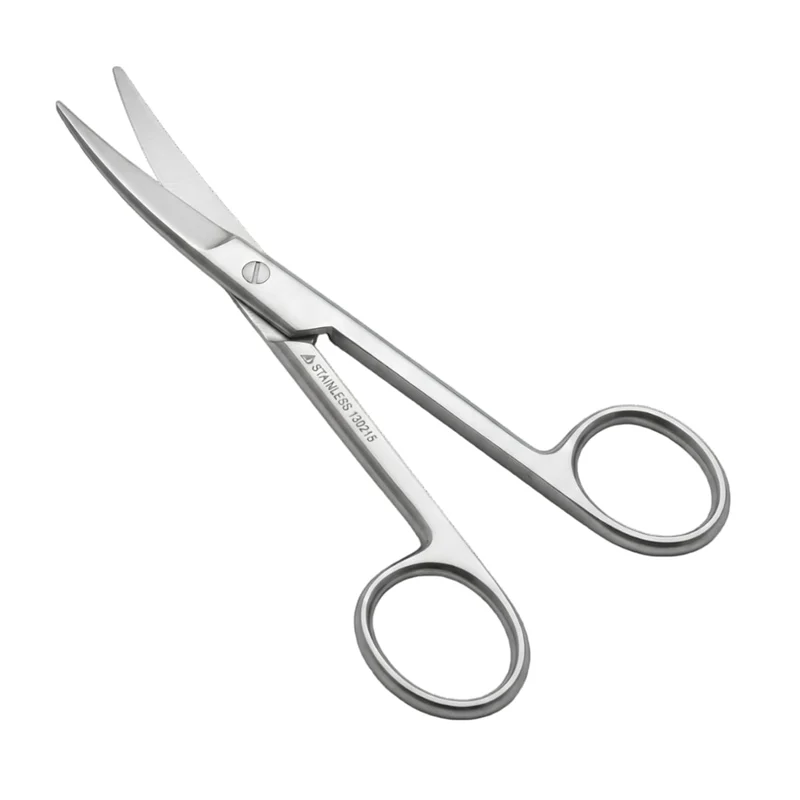
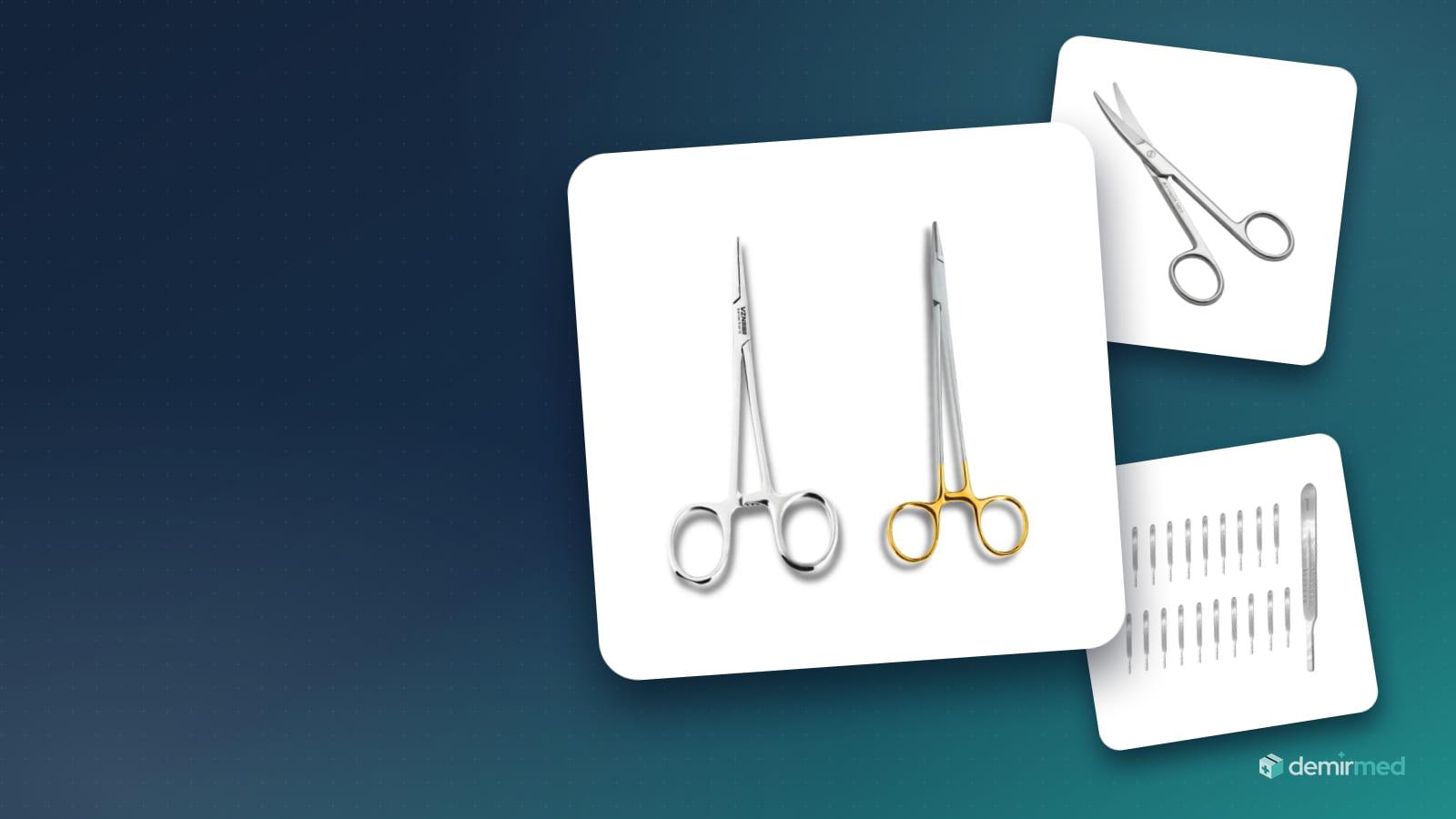
Suturing instruments
Needle holder, scissors, scalpel
What affects the choice of suture?
The same incision can be closed with two different threads by two physicians; several factors are weighed together.
- Site and skin thickness: thin sizes are preferred where the skin is thin, such as the face, thicker sizes where it is thick, such as the back and the scalp.
- Tension: over joints and in mobile areas the wound edges are pulled harder; the thread has to carry that load.
- Layer: deep layers are mostly closed with absorbable thread, the skin surface with absorbable or non-absorbable thread as the physician prefers.
- Expected scar: a thin thread and a suitable needle leave less of a mark; in aesthetic areas this comes first.
- Follow-up: for a patient who cannot come back to have stitches removed, absorbable thread makes things easier.
This list is for planning purchases; which thread is used on which patient is the physician's decision.
Common mistakes when ordering
- Writing only the size: "4-0 suture" alone is not enough; whether it is absorbable and the needle type must be stated too.
- Leaving out the needle: the same size comes with a round needle and with a reverse cutting needle; the wrong needle makes the procedure harder.
- Assuming the quantity per box: the number of packs in a box differs by product code; the quantity is calculated from the label.
- Not checking the expiry date: rarely used sizes wait on the shelf; a box with a short date may be too much for the rate of use.
- Stocking a single size: different sites need different thicknesses; every size the physician uses should be on the list.
How are sutures stored and opened?
- Sutures come in individual sterile packs; a pack is not opened until the moment of use.
- A suture with a torn or wet pack, or past its expiry date, is not used.
- A suture that was opened but not used is not re-sterilised; it is discarded.
- Boxes are stored under the conditions stated by the manufacturer, in a dry cabinet out of direct sunlight.
- The box with the nearest expiry date goes to the front; entering the lot number in the patient record makes tracing back easier.
Monthly quantity plan: how many boxes are needed?
The sum is simple: procedures per month × packs per procedure, divided by the packs in a box and rounded up. The example below is for a box of 12 packs; since the quantity per box can differ by product code, check the label of your own box.
| Procedures per month | Packs per procedure | Packs needed | Boxes of 12 |
|---|---|---|---|
| 10 | 2 | 20 | 2 boxes |
| 25 | 2 | 50 | 5 boxes |
| 50 | 2 | 100 | 9 boxes |
A clinic that uses more than one size makes the sum for each size separately. A small reserve for dropped or contaminated packs avoids looking for thread in the middle of a procedure.
Purchasing checklist
- The size is settled: 3-0, 4-0 or 5-0; the sizes the physician uses are listed.
- The choice between absorbable and non-absorbable thread is written down.
- The needle type is stated: point, curvature and length, or simply the product code.
- Thread length and quantity per box are stated in the quotation.
- The expiry date is long enough for the rate of use; the lot number is on the delivery note.
- Needle holder, surgical scissors and scalpel are in the same order.
- Sterile gloves, drape, swabs and a sharps container are planned.
- CE and UTS documents are requested at the quotation stage and shared once verified.
Related products in the Demir Med catalogue
Sutures are in the Surgical Consumables category, suturing instruments in Surgical Instruments: Monocryl 3-0, Monocryl 4-0, Monocryl 5-0, the needle holder and surgical scissors. For dressing materials see gauze or gauze swab. Products are sold by quotation: state the sizes you use, the needle type and your monthly number of procedures and request a quote; a PDF quotation is sent within 1 business day.