Short answer
A pulse oximeter is a non-invasive device, usually clipped onto a fingertip, that uses light to measure blood oxygen saturation (SpO2) and pulse rate (PR). In a healthy adult at rest at sea level, SpO2 is usually 95–100%. Readings of 91–94% call for clinical evaluation, and 90% or below is generally significant hypoxaemia that needs prompt medical assessment. The treating clinician sets each patient's target range.
What is a pulse oximeter, and what does "pulse" mean?
A pulse oximeter is also called an oximeter, a saturation monitor, an oxygen meter or a fingertip oxygen monitor. It estimates what percentage of the haemoglobin in arterial blood is carrying oxygen, within seconds and without drawing blood. The word pulse refers to the heartbeat: the device takes its name from the fact that it measures only the arterial blood that pulsates with each beat.
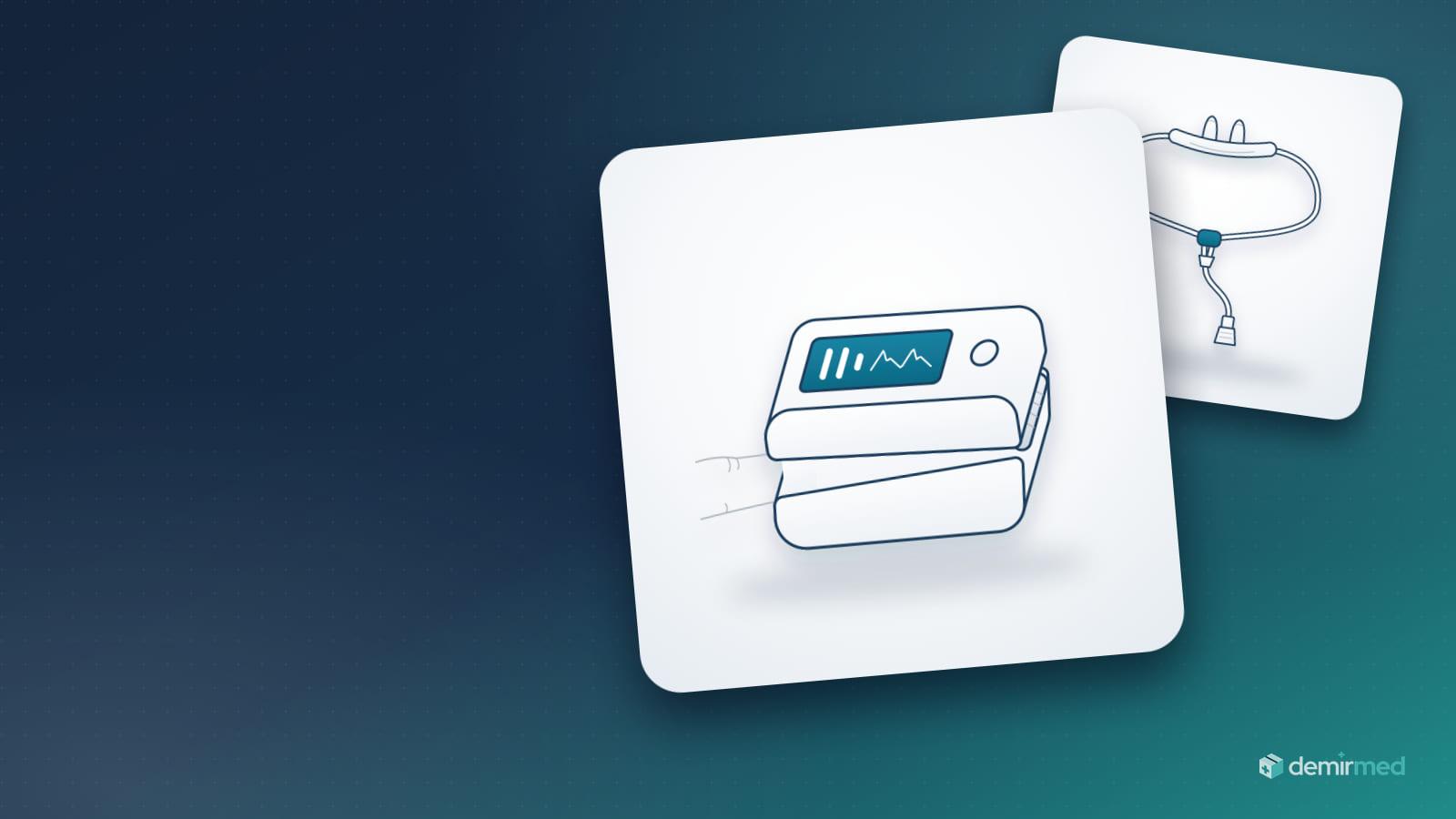
Pulse oximetry is now part of the standard set of vital signs. It is used at triage, on ward rounds, during procedures under sedation or local anaesthesia, in ambulances and in home care. The fingertip pulse oximeter is the most common example of the group: it closes on the finger like a clip and shows SpO2 and pulse rate on the digital display on its housing.
What does the display show?
| Indicator | Stands for | Unit | What it tells you |
|---|---|---|---|
| SpO2 | Peripheral oxygen saturation | % | Estimated share of functional haemoglobin that is carrying oxygen |
| PR | Pulse rate | beats/min (bpm) | Number of pulse waves the sensor detects at the finger |
| PI | Perfusion index | % | Ratio of the pulsatile to the steady signal; an indicator of signal strength |
| Pleth | Plethysmograph waveform or bar graph | Graphic | The waveform of each beat; a visual check of measurement quality |
What does SpO2 mean? In the abbreviation, S stands for saturation, p for peripheral (some sources say "pulse") and O2 for oxygen. The common spelling "sp02" simply uses a zero instead of the letter O and refers to the same value. SpO2 is a non-invasive estimate of SaO2, the arterial saturation measured by co-oximetry on a blood gas sample. It is not the same as PaO2, the partial pressure of oxygen dissolved in blood: one is a percentage, the other is given in mmHg or kPa.
Why do PI and the pleth matter? Because manufacturers scale PI differently, it cannot be compared between brands; it is followed as a trend on the same device. Regular, similar waves indicate a reliable signal. A flat, saw-tooth or irregular waveform points to motion, poor perfusion or a misplaced probe, and the SpO2 shown at that moment should not be trusted.
How does a pulse oximeter work?
Inside the device are two light sources (LEDs) and, opposite them, a photodetector. In a fingertip device, light enters one side of the finger, passes through the tissue and reaches the detector on the other side; this is called transmission. Forehead, wrist and smartwatch sensors instead measure light reflected back from the tissue (reflectance). A measurement works in four steps:
- Two wavelengths: the device uses red light at about 660 nm and infrared light at about 905–940 nm. Oxygenated haemoglobin (oxyhaemoglobin) absorbs more infrared and less red light. Deoxygenated haemoglobin (deoxyhaemoglobin) absorbs markedly more red light.
- The pulsatile signal: most of the light passing through tissue is absorbed at a steady level by skin, muscle, bone and venous blood; this is the steady (DC) component. With each heartbeat, arterial blood arriving in the finger causes a small, rhythmic rise in absorption, the pulsatile (AC) component. By analysing only this pulsatile part, the device separates arterial blood from the surrounding tissue.
- The ratio of ratios: the processor divides the pulsatile-to-steady ratio at red by the same ratio at infrared, giving a value called "R". R is converted into an SpO2 percentage using a calibration curve that the manufacturer built by comparing readings with arterial blood gases in healthy volunteers. When R is about 1, the display shows roughly 85%.
- Ambient-light correction and averaging: the LEDs switch on and off in turn hundreds of times per second. In the brief moments when both are off, the detector measures ambient light and subtracts it. The number on the display is an average over several seconds, so a real change appears with a delay of a few seconds.
This principle has three practical consequences: if pulsatile flow is weak (cold hands, shock), the device cannot measure reliably; carboxyhaemoglobin and methaemoglobin mislead a standard two-wavelength device; and because calibration is done in healthy volunteers, accuracy falls at very low values.
What is a normal oxygen saturation? SpO2 reference values
Whether the question is "what should my oxygen saturation be", "what is a normal SpO2" or "what is a normal fingertip oxygen reading", the short answer is the same: in a healthy adult at rest at sea level, SpO2 is usually 95–100%. The same range answers "what should blood oxygen level be", but remember that a pulse oximeter shows how saturated haemoglobin is, not how much oxygen the blood contains. The table below is an educational, typical framework for interpretation. Thresholds vary with local protocol and the patient's clinical condition.
| SpO2 (room air, at rest) | Typical interpretation | General approach |
|---|---|---|
| 95–100% | Usual range for a healthy adult | Routine monitoring alongside the clinical picture |
| 91–94% | Below normal; may be the baseline in some people with chronic lung disease | Confirm the reading, review previous values and the clinical picture, inform the clinician |
| 86–90% | Significant hypoxaemia | Prompt medical assessment; the clinician decides on oxygen |
| 85% or below | Severe hypoxaemia | Urgent assessment and the local emergency protocol |
SpO2 alone does not make a diagnosis. It is interpreted together with respiratory rate, level of consciousness, skin colour, pulse and the patient's symptoms; clinical decisions belong to the physician and the institution's protocol.
Target saturation ranges: acutely ill patients and COPD
When oxygen is given, the aim is not to push saturation "as high as possible" but to keep it within a defined target range. The British Thoracic Society (BTS) oxygen guideline recommends 94–98% for most acutely ill patients. For patients at risk of hypercapnic respiratory failure, the recommended target is 88–92%. This group includes some patients with COPD, those with obesity hypoventilation, severe chest-wall deformity or neuromuscular disease. In these patients, more oxygen than needed can increase carbon dioxide retention. The clinician decides which range applies to which patient, and the target is written in the patient record and on the observation chart.
A physiology note: the oxyhaemoglobin dissociation curve is S-shaped. An SpO2 of 90% corresponds to a PaO2 of about 60 mmHg (8 kPa), and below this point small falls in PaO2 cause rapid falls in saturation. On the upper, flat part of the curve, PaO2 can change considerably while SpO2 stays between 97% and 100%. A high SpO2 in a patient on oxygen can therefore mask deteriorating breathing for a while; the BTS guideline also advises against unnecessarily high saturations and sets an upper limit of 98% for acutely ill patients.
Altitude, sleep, age and children
- High altitude: because the partial pressure of oxygen in the air is lower, SpO2 can read a few points lower than at sea level even in healthy people.
- Sleep: breathing becomes shallower during sleep, so brief, mild dips are normal. Repeated marked dips are assessed for conditions such as sleep apnoea.
- Older age: PaO2 declines slightly with age, but in healthy older adults SpO2 usually remains in the normal range. A low reading should not be explained away by age alone.
- Children and newborns: the usual range in infants and children is similar to adults. In newborns, SpO2 rises gradually over the first minutes after birth; targets follow the neonatal resuscitation protocol, and an age-appropriate probe is used.
What is a normal pulse rate?
The PR value on the display is the pulse rate. A normal resting pulse in adults is about 60–100 beats per minute. A rate below 60 can be normal in people who exercise regularly, and children have higher rates depending on age. A pulse oximeter counts the pulse waves that reach the finger. In arrhythmias such as atrial fibrillation, some beats do not produce an adequate peripheral wave, so the PR can appear lower than the heart rate on the ECG. When in doubt, compare with the apical pulse or the ECG.

How it works
Measuring SpO2 with red and infrared light
How accurate is a pulse oximeter? Causes of false readings
Accuracy limits
Manufacturers typically state SpO2 accuracy as ±2 points over the 70–100% range, or ±3 points for some models. This figure is calculated as Arms (root-mean-square error) in volunteer studies performed under ISO 80601-2-61, in which device readings are compared with SaO2 from arterial blood gases. The standard requires Arms to be no more than 4 points over this range. In practice this means:
- Accuracy is expressed in percentage points. On a device with ±2 accuracy, a reading of 92% usually means the true SaO2 lies roughly between 90% and 94%.
- Arms is a statistical value. Most readings fall within this band, but individual readings can deviate further.
- Values below 70% are outside the calibration range and are not considered numerically reliable; in this zone the device indicates only direction and trend.
- Pulse-rate accuracy is stated separately and is usually within a few beats per minute.
- A pulse oximeter does not measure ventilation. In a patient receiving oxygen, SpO2 can stay normal while carbon dioxide builds up, and in a sedated patient respiratory depression shows up late in SpO2. Where ventilation must be monitored, capnography and clinical observation are needed.
Error sources and practical fixes
| Error source | Possible effect | Practical fix |
|---|---|---|
| Cold hands, poor perfusion (shock, hypothermia, vasoconstriction) | No reading, fluctuating or low values | Warm the hand, try another finger, check the PI; use an earlobe probe if needed |
| Motion, shivering, seizures | Falsely low or high SpO2, wrong pulse rate | Rest the hand on a firm surface and wait until the waveform settles |
| Nail polish (especially dark), gel polish, artificial nails | Low readings or no reading | Remove polish from the finger used, or choose a finger without nail products |
| Bright ambient light (theatre lamps, sunlight, phototherapy) | Signal interference, wrong values | Cover the sensor with an opaque material |
| Wrong probe size or position | Light bypassing tissue (optical shunt), falsely low or high values | Insert the finger fully, use a paediatric probe for children; emitter and detector must face each other |
| Blood pressure cuff on the same arm | Loss of signal and false alarms while the cuff inflates | Move the sensor to the other arm |
| Arrhythmia (e.g. atrial fibrillation) | Irregular or low PR, unstable SpO2 | Wait for a stable waveform; confirm the pulse by ECG or apical pulse |
| Carbon monoxide poisoning | Carboxyhaemoglobin reads as oxyhaemoglobin; SpO2 falsely normal or high | Do not rely on SpO2 when CO is suspected; use a co-oximetry blood gas or an SpCO-capable device |
| Methaemoglobinaemia | Reading drifts towards about 85% regardless of true saturation | Confirm with co-oximetry on an arterial blood gas |
| Severe anaemia | Weaker signal; blood oxygen content is low even when SpO2 is normal | Interpret together with the haemoglobin value |
| Intravenous dyes (e.g. methylene blue) | Temporary falsely low readings | Record the time of administration; confirm with a blood gas if needed |
| Darker skin pigmentation | SpO2 may read higher than the true value | Look at trends and the clinical picture rather than one number; request a blood gas when they do not match |
Three situations in the table deserve special attention:
- Carbon monoxide: in Türkiye, carbon monoxide poisoning from stoves, gas water heaters and boilers is common, especially in winter. In these patients the pulse oximeter may show 98–100%; a normal SpO2 does not rule out poisoning.
- Methaemoglobinaemia: some local anaesthetics such as benzocaine and prilocaine, as well as dapsone and nitrite or nitrate compounds, can raise methaemoglobin levels. Because methaemoglobin absorbs similarly at both wavelengths, R approaches 1 and the reading drifts towards about 85%. Unexplained cyanosis with an SpO2 stuck near 85% during high-dose local anaesthesia should raise this suspicion.
- Skin pigmentation: in a 2021 safety communication, the US Food and Drug Administration (FDA) stated that skin pigmentation, poor circulation, skin thickness, skin temperature, tobacco use and nail polish can affect accuracy. SpO2 may be overestimated in people with darker skin, so occult hypoxaemia can be missed.
Normal values
What is a normal SpO2? Typical ranges
How to use a pulse oximeter: correct measurement technique
Correct technique often changes the result more than the difference between devices does. For a spot (one-off) measurement, follow this sequence:
- Let the patient rest. Have the patient sit or lie quietly for about 5 minutes before measuring. A reading taken straight after walking or climbing stairs does not reflect the resting value.
- Warm the hands. If the hands are cold, warm them by rubbing or by waiting in a warm room; a cold finger is the most common cause of error.
- Prepare the finger. Remove nail polish, artificial nails or dirt. The index or middle finger is usually preferred. Where possible, avoid the arm with a blood pressure cuff and the hand with an IV line.
- Fit the device correctly. Insert the finger fully into the device, with the nail facing the direction shown in the instructions for use (the top side on most models). The clip should neither squeeze the finger nor sit loosely.
- Keep the hand at heart level and still. Resting the hand on a surface at chest level reduces motion artefact. Ask the patient not to move the finger.
- Wait for a stable reading. Wait about 30–60 seconds until the value and the waveform are regular; if the value is still changing, wait longer.
- Read the right value. Use the highest value that stays stable for several seconds, not a momentary spike or dip. If the waveform is poor, do not use the value; repeat the measurement.
- Record it. Note SpO2 and pulse rate together with the time, the site and whether the patient is on room air or oxygen (with flow rate and delivery device). Example: "SpO2 95%, PR 82, room air, at rest, 14:20".
Points to watch during continuous monitoring
- Set the monitor's alarm limits to the patient's target range, and do not silence alarms permanently.
- Remember that clip probes can cause pressure and heat injury. Check and change the sensor site at the intervals in the manufacturer's instructions; this matters even more in newborns, older patients and patients with oedema.
- Treat a low reading as real first: assess the patient, then check the probe, its position and the waveform.
Cleaning, disinfection and storage
- Between patients, wipe the finger chamber and the housing with the disinfectant the manufacturer recommends (an alcohol wipe for most models); do not immerse the device.
- Do not reuse single-use adhesive sensors, and keep liquid out of the battery compartment.
- Remove the batteries from devices that will not be used for a long time; a leaking battery can damage the device permanently.
Types of pulse oximeter: fingertip, handheld, monitor and wearable
The right saturation monitor depends on whether you need spot checks or continuous monitoring and on the patient group. The main types on the market are:
| Type | Typical use | Strength | Limitation |
|---|---|---|---|
| Fingertip | Spot checks, triage, outpatient clinics, home care, ambulances | Small, battery-powered, quick and easy to use | Most have no alarms or memory; may not fit very small fingers |
| Handheld with cable probe | Wards, emergency, patient transport, paediatrics | Adult, paediatric and neonatal probes can be attached; some have alarms and memory | Larger; probes need care and spares |
| Bedside monitor | Intensive care, operating theatre, recovery, sedation | Continuous monitoring, alarms and trends; combined with ECG, blood pressure and capnography | Fixed use; needs installation, maintenance and staff training |
| Wrist-worn (with finger sensor) | Overnight recording, long-term monitoring | Freedom of movement, data logging | Software is needed to analyse recordings |
| Smartwatches and wearables | Personal tracking | Worn continuously | Not for diagnosis or clinical decisions unless it is a medical device |
| Paediatric and neonatal probes | Infants and children | Correctly sized sensors wrapped around the foot, hand or finger | Must be compatible with the monitor or handheld device in use |
Fingertip devices are aimed at the spot-check needs of outpatient clinics, private practices, ambulance and home-care teams. Units that use sedation, and operating theatres, need a monitor with alarms that can monitor continuously. Earlobe and forehead probes are also available on the market and can be an option in patients with very poor peripheral circulation.
The "blood oxygen" features in smartwatches are mostly offered for general wellness and measure by reflectance at the wrist. Watches, bands or oximeters labelled "for sports use" that are not medical devices do not replace clinical measurement.
Clinic buying checklist for pulse oximeters
Selection criteria
- Display type and readability: OLED or colour displays are easier to read from different angles and in dim light; a rotating display helps with a patient lying down. In ambulances, readability in daylight matters.
- Pleth and PI indicator: to judge measurement quality, choose a model that shows a waveform or bar graph and the perfusion index.
- Stated accuracy: the technical specifications should state SpO2 and pulse-rate accuracy, the measuring range and performance at low perfusion.
- Alarms: for continuous monitoring (sedation, recovery, transport), choose a monitor or handheld device with high and low SpO2 and pulse alarms. Most fingertip devices are intended for spot checks.
- Battery and auto-off: the battery type and approximate operating time should be stated in the quotation. Automatic switch-off when the finger is removed and a low-battery warning reduce the risk of a flat device at a critical moment.
- Cleaning and disinfection: the instructions for use should list which disinfectants are compatible. An ingress protection (IP) rating against liquids is an advantage under heavy use.
- Paediatric suitability: the finger thickness range a fingertip device suits is given in the instructions. Units that treat children should consider a handheld device that accepts paediatric probes.
- Regulatory and labelling: the device should carry the CE mark and be registered in Türkiye's ÜTS (Product Tracking System). Look for Turkish instructions for use and labelling, and ask for the serial number to appear on the delivery note.
- Calibration and checks: pulse oximeters are not calibrated by the user. SpO2 simulators check that the device works and displays consistently, but they do not prove clinical accuracy. A device giving doubtful readings should be withdrawn from use and sent for service.
Stocking, storage and disposal checklist
- One device per examination or procedure room, a separate device for the emergency bag and crash cart, and at least one spare against breakdowns and flat batteries
- Spare batteries for every device and a record of battery change dates
- Correctly sized probes and a compatible device if children or newborns are treated
- Dry storage at room temperature away from direct sunlight; within the temperature and humidity range in the instructions, with batteries removed for long-term storage
- A protective case or lanyard against drops and knocks
- Serial number, delivery date and periodic function checks entered in the biomedical inventory
- The device is non-sterile and reusable; at the end of service life, devices and batteries follow electronic-waste and battery rules, and single-use probes follow the institution's waste plan
To set stock levels, see our clinic stock management guide, and for procedure-room equipment the hair transplant clinic equipment checklist. For the other devices in an examination room, read our otoscope, ophthalmoscope and negatoscope guide.
Equipment used with a pulse oximeter in oxygen therapy
When SpO2 is low and the physician starts oxygen, the flow rate is adjusted to keep saturation within the target range and is monitored with the pulse oximeter. A basic set for clinic and ambulance stock consists of:
- Oxygen source: portable medical oxygen cylinders usually come in 2 L, 5 L and 10 L capacities with a pressure gauge and carry bag. A regulator and flowmeter that fit the cylinder are needed to set the flow; the valve and connection type are clarified at purchase.
- Nasal cannula: delivers oxygen directly into the nostrils through two prongs. With the mouth free, the patient can talk and eat. It is typically used at low flows of about 1–6 L/min.
- Simple face mask: covers both mouth and nose and usually comes with about 2 m of tubing. It is typically used at about 5–10 L/min. Lower flows are not recommended because exhaled air collecting in the mask may be rebreathed.
- Other masks: Venturi masks that deliver a fixed oxygen percentage and reservoir masks that deliver high concentrations are also available on the market.
Flow rate, delivery device and target saturation are set by the physician's order and local protocol.
How long does an oxygen cylinder last?
As a rough estimate, the volume of oxygen in a cylinder (litres) is approximately the cylinder's water capacity (litres) multiplied by the pressure on the gauge (bar). For example, a 5 L cylinder showing 150 bar holds about 750 L of oxygen; at 2 L/min that lasts about 375 minutes, or just over 6 hours. Actual duration depends on fill pressure and flow setting; change the cylinder before it runs empty and keep a spare ready.
Alongside the pulse oximeter and oxygen source, an emergency bag also holds advanced airway equipment and IV access supplies. For advanced airway equipment, see our laryngoscope and blade types guide; for choosing IV access supplies, see the IV cannula colours and gauges guide.

Buying
Choosing a pulse oximeter for the clinic
Product availability
Demir Med does not carry pulse oximeters, oxygen cylinders, oxygen masks or nasal cannulas in its catalogue; this guide is for information on saturation measurement and device selection. For a clinic set-up list, see the Medical Equipment and Medical Consumables categories, and send specific needs for catalogue products through a quote request.
Sources and standards
- ISO 80601-2-61: Medical electrical equipment — Particular requirements for basic safety and essential performance of pulse oximeter equipment
- British Thoracic Society (BTS): Guideline for oxygen use in adults in healthcare and emergency settings (2017)
- US Food and Drug Administration (FDA): Pulse Oximeter Accuracy and Limitations, safety communication (2021)
- World Health Organization (WHO): Pulse Oximetry Training Manual (2011)
- Turkish Medicines and Medical Devices Agency (TİTCK): Medical Device Regulation and the Product Tracking System (ÜTS)