Short answer
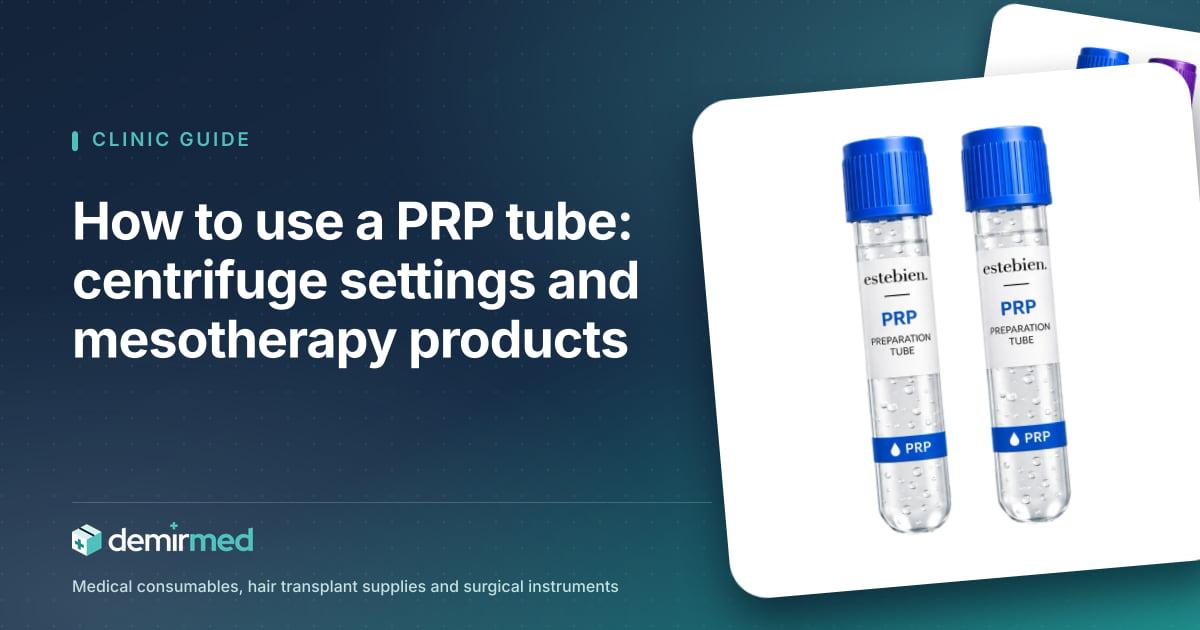
A PRP tube is a closed tube used to prepare platelet-rich plasma (PRP) from the patient's own blood. Using it comes down to four steps: check the label of the box and the tube, draw the volume of blood the label states and mix the tube gently, centrifuge it at the g-force and time the manufacturer gives, then draw off the separated plasma with a sterile syringe. What matters in the centrifuge is not the speed (rpm) on the display but the g-force, which depends on the rotor radius; the conversion formula and ready-made tables are below. Where, how much and in how many sessions the plasma is applied is the physician's decision.
On the PRP side, the Demir Med catalogue lists the Estebien PRP Preparation Tube and two combined boxes that come with a PRP tube; on the mesotherapy side, products by Drmeso, Gebro, Greft Plus and Hairoos; and on the equipment side, a centrifuge. All are sold to clinics and healthcare professionals by quotation.
What is PRP?
PRP (platelet-rich plasma) is plasma obtained from a person's own blood by centrifugation, with a higher platelet concentration than the blood it came from. The blood is collected in a PRP tube; in the centrifuge the red blood cells settle at the bottom while the platelets and plasma collect in the upper part of the tube. In what is commonly called PRP treatment or hair PRP, this plasma is applied by a physician in procedures such as hair transplantation and hair mesotherapy. Who it suits, how many sessions and at what interval are decided by the physician who examines the patient; this article covers the supplies a clinic uses, not the application itself.
Exosome, on the other hand, is a term found in the names of some mesotherapy products and should not be confused with PRP: PRP is prepared in the clinic from the patient's own blood, while products sold under the exosome name are ready-made products prepared by their manufacturers.
PRP and mesotherapy products: what the catalogue lists
The table below lets a clinic that prepares PRP and performs hair mesotherapy tell the products on this page apart at a glance. Box contents come from the product pages; where a product name carries a number, it gives the count per box, and the unit volume and contents are on the label and in the quotation.
| Product | What is in the box? | Product type |
|---|---|---|
| Estebien PRP Preparation Tube | 2 blue-capped PRP preparation tubes | PRP preparation tube |
| Estebien Meso Solution Tube | 1 PRP tube + 1 green-capped Meso Solution Tube | Combined PRP and solution box |
| Estebien Exocell Solution Tube | 1 PRP tube + 1 purple-capped Exocell Solution Tube | Combined PRP and solution box |
| Drmeso Mesotherapy 5 × 10 ml | 5 × 10 ml, as the name says | Branded mesotherapy product |
| Drmeso Exo 5 × 3 ml | 5 × 3 ml, as the name says | Product sold under the exo (exosome) name |
| Gebro Exosome | Box contents in the quotation | Product sold under the exosome name |
| Greft Plus Mesotherapy, box of 10 | Box of 10 | Branded mesotherapy product |
| Hairoos Mesotherapy, box of 8 | Box of 8 | Branded mesotherapy product |
| Centrifuge | 1 unit; rotor, tube capacity and speed range in the quotation | Equipment for PRP and sample preparation |
| 30 G 13 mm Needle | Fine needle with a Luer hub | Needle for intradermal application |
Branded mesotherapy and exosome products are for professional use only and are applied by a physician. Contents, storage conditions and expiry date are on the manufacturer's label; Demir Med makes no claim about their contents or results.
How to prepare PRP: using a PRP tube step by step
The sequence below is the general workflow of clinics that work with closed PRP tubes. Blood volume, mixing, centrifuge force and time can differ from tube to tube; the instructions in the box always take precedence.
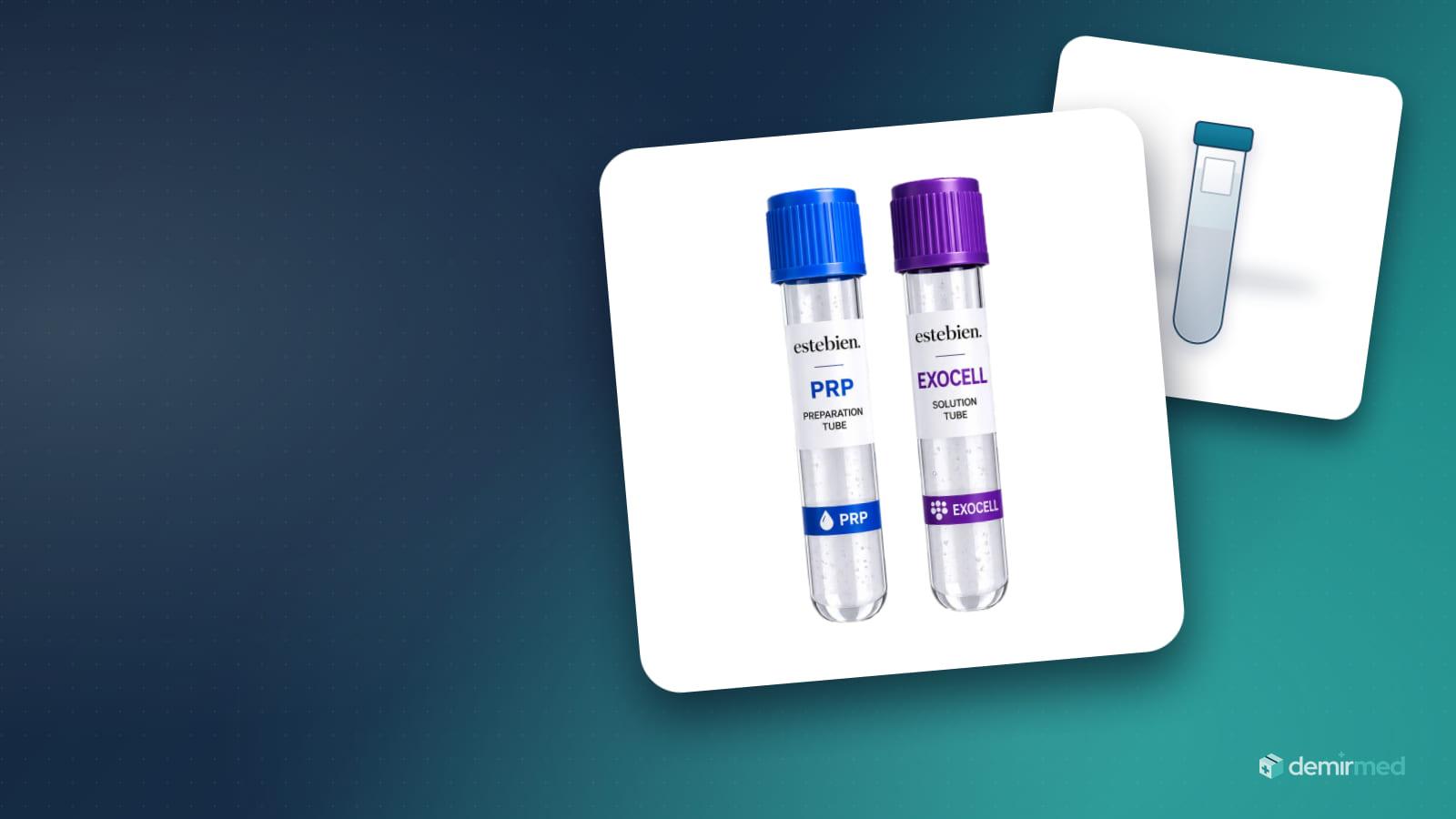
- Check the label and the box. Is the packaging intact, is the expiry date still ahead, is the lot number legible? Read the blood volume on the label, whether the tube contains an anticoagulant or a separator gel, and the recommended centrifuge setting. In the Estebien line the PRP preparation tube has a blue cap.
- Prepare the centrifuge. Select the programme; if the device only shows speed, convert the g value into rpm with the formula below. If you are spinning a single tube, set aside a balance tube filled with the same volume of water.
- Draw the blood. Gloves, skin antiseptic, a tourniquet and a blood collection needle or set should be ready. Blood is collected the way the instructions describe (by vacuum or by transferring it from a syringe) and in the stated volume. Under- or over-filling changes the ratio of blood to the additive in the tube.
- Mix the tube gently. Tubes containing an anticoagulant are inverted slowly a few times right after collection; the number of inversions is in the instructions. The tube is not shaken.
- Centrifuge. Tubes go into the rotor opposite each other and equally filled, and the lid is closed. The g-force and time from the instructions are applied; the lid is not opened before the rotor has stopped completely.
- Check the layers. The tube is lifted out upright, without jolting. Red blood cells sit at the bottom, a thin whitish layer (the buffy coat) in the middle, and yellowish plasma on top. In gel separator tubes the gel forms a barrier between the red cells and the plasma.
- Draw off the plasma. The plasma is drawn with a sterile syringe from the layer and in the volume set out in the physician's protocol. How the solution tube in a combined box is used is written in that box's own instructions.
- Application and waste. The physician performs the application. Used needles go into the sharps container; tubes and supplies that touched blood go into medical waste. An opened tube is used only for that patient and that session.
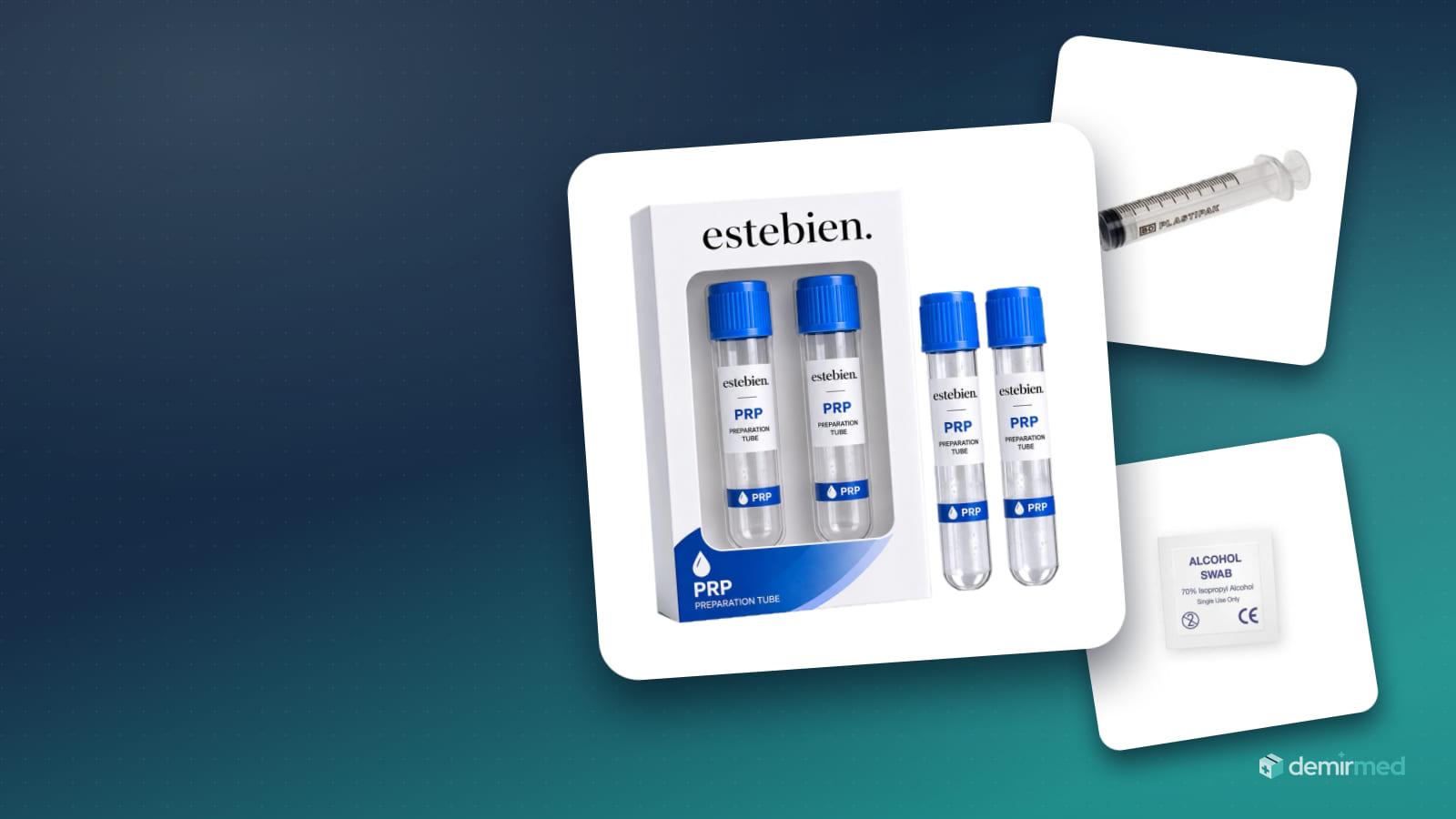
PRP preparation
Label, blood, mixing, centrifuge, plasma
PRP centrifuge settings: from rpm to g-force
The rpm on a centrifuge display is the number of rotor revolutions per minute. What separates the blood in the tube is the g-force (RCF, relative centrifugal force): it states how many times the force of gravity acts on the tube. The same rpm gives a higher g-force as the rotor radius grows. That is why tube manufacturers write their instructions in g; a figure such as "3,000 rpm" means little on its own without the device's radius.
The conversion formula is (r: rotor radius in centimetres):
- g-force = 1.118 × 10⁻⁵ × r × rpm²
- rpm = √(g-force ÷ (1.118 × 10⁻⁵ × r))
The rotor radius is usually stated in the device manual as the "maximum radius". Without a manual, measure from the centre of the rotor to the bottom of the tube in its spinning position. Many newer devices let you enter the g value directly, in which case the device does the calculation.
g-force by rpm
| rpm | r = 8 cm | r = 10 cm | r = 12 cm | r = 15 cm |
|---|---|---|---|---|
| 1,000 | 89 g | 112 g | 134 g | 168 g |
| 1,500 | 201 g | 252 g | 302 g | 377 g |
| 2,000 | 358 g | 447 g | 537 g | 671 g |
| 2,500 | 559 g | 699 g | 839 g | 1,048 g |
| 3,000 | 805 g | 1,006 g | 1,207 g | 1,509 g |
| 3,500 | 1,096 g | 1,370 g | 1,643 g | 2,054 g |
Speed needed for a target g-force
| g in the instructions | r = 8 cm | r = 10 cm | r = 12 cm | r = 15 cm |
|---|---|---|---|---|
| 300 g | 1,831 rpm | 1,638 rpm | 1,495 rpm | 1,338 rpm |
| 500 g | 2,364 rpm | 2,115 rpm | 1,931 rpm | 1,727 rpm |
| 1,000 g | 3,344 rpm | 2,991 rpm | 2,730 rpm | 2,442 rpm |
| 1,500 g | 4,095 rpm | 3,663 rpm | 3,344 rpm | 2,991 rpm |
The figures in the tables are worked examples only, not a protocol recommendation. If the instructions say 1,000 g, for example, a device with a 10 cm radius is set to about 2,990 rpm and one with a 15 cm radius to about 2,440 rpm. Spinning the same tube at the same rpm in two different devices means applying two different forces.
The time also comes from the instructions. If your device has acceleration and brake levels, choose them according to the instructions: a hard brake stops the rotor abruptly and can mix layers that have already separated.
Centrifuge settings
g = 1.118 × 10⁻⁵ × r × rpm²
Choosing a centrifuge: tube, rotor and display
When buying a centrifuge for PRP, three questions decide whether it fits the daily work.
- Tube size: The rotor buckets or adapters must take the diameter and length of the tube you use. Put the tube size or name in your request; the fit is confirmed at the quotation stage.
- Rotor type: In a fixed-angle rotor the tube spins at a fixed tilt, the layers form at a slant and level out when the device stops. In a swing-out rotor the tube swings to horizontal while spinning, and the layers form flat and square to the tube. The tube manufacturer's instructions say which one suits.
- Capacity and display: The rotor is loaded in pairs, opposite each other; your tubes per session multiplied by the number of patients prepared at the same time sets the capacity. A display that shows g directly, programme memory, a lid lock and an imbalance alarm make daily use easier.
The Centrifuge in the catalogue is sold per unit; the rotor type, tube capacity and speed range of the supplied model are stated in writing in the quotation.
Mesotherapy solutions and exosome products: how to compare the boxes
Mesotherapy solutions and products sold under the exosome name are branded products prepared by their manufacturers. Which one is applied to which patient, with which technique and over how many sessions is the physician's decision. On the purchasing side, what you compare are the measurable facts:
| Criterion | Why it matters | Where it is written |
|---|---|---|
| Count and unit volume per box | Sets the units opened per session and the boxes needed per month | In the product name (5 × 10 ml, 5 × 3 ml, box of 8, box of 10) and in the quotation |
| Storage condition | Shows whether the clinic needs a refrigerator or a separate cabinet | The manufacturer's label |
| Use after opening | Decides whether an opened unit must be used up in the same session | The instructions for use |
| Expiry date and lot | Sets how much stock you can hold at your rate of use | The packaging and the delivery note |
| Professional-use statement and language of the instructions | Shows the product is labelled for clinical use | The packaging |
What to know about exosome products
"Exosome", "exo" and "exocell" are the manufacturers' product names. The contents, source and instructions for use are on the label; Demir Med makes no claim about the contents, source or results of these products. In the clinic they are handled like other mesotherapy products: the storage condition on the label, the use-by time after opening and the physician's protocol apply. CE and UTS documents for the product are shared with the quotation once verified.
Estebien cap colours: blue, green and purple
In the Estebien Mesotherapy & PRP line the boxes are told apart by cap colour:
- Blue cap: PRP Preparation Tube; the PRP preparation tube box holds two.
- Green cap: Meso Solution Tube; the Meso box comes with one PRP tube.
- Purple cap: Exocell Solution Tube; the Exocell box comes with one PRP tube.
The colour scheme keeps tubes from getting mixed up when several boxes are opened on the same tray. Whoever prepares the tray can match the cap colour to the patient's session record. For a detailed comparison of the three boxes and the whole session tray, see the hair mesotherapy supplies guide.
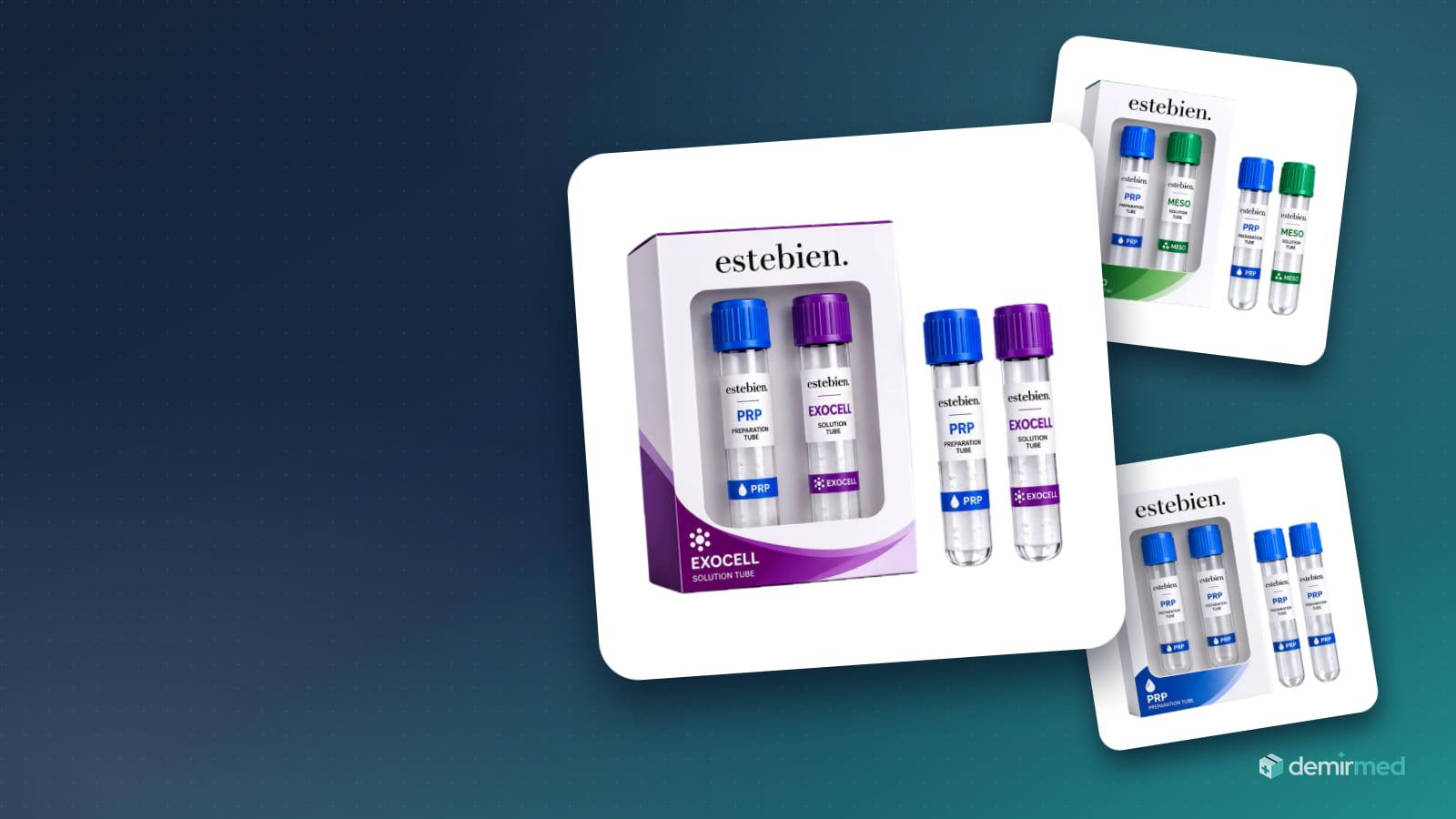
Cap colours
Blue PRP · green Meso · purple Exocell
Supply list for a PRP session
PRP preparation does not end with the tube and the centrifuge; supplies for drawing blood, drawing off the plasma and the application must be ready too.
- Blood collection: examination gloves, skin antiseptic and alcohol swabs (disinfection and hygiene), a tourniquet, a blood collection needle or set.
- Drawing off the plasma: a sterile syringe; for larger volumes the 10 cc Luer lock syringe.
- Application: a 1 cc syringe and the fine needle the physician chooses, for example the 30 G 13 mm needle. For mesotherapy needle sizes, see the 30G–32G table in the hair mesotherapy supplies guide.
- Asepsis and waste: sterile gauze or swabs, a sharps container, a medical waste bag.
8 common mistakes
- Setting the centrifuge by rpm: if the g value from the instructions is not converted to rpm with the device's radius, the tube spins at a lower or higher force than intended.
- Loading the rotor unbalanced: a single tube is never spun without a balance tube; tubes go in opposite each other and equally filled.
- Under- or over-filling the tube: the ratio of additive to blood changes.
- Forgetting to mix, or shaking the tube: an anticoagulant tube is inverted slowly, not shaken.
- Jolting the tube after centrifugation: the separated layers mix; carry the tube upright and steady.
- Applying one protocol to different tubes: every brand's tube is used with its own instructions.
- Stocking without reading the storage condition: a product that needs a refrigerator is not left at room temperature; an opened box is not kept for the next session.
- Not recording lot and expiry date: if a question arises about a product, you need to know which lot was used on which patient.
What to include in a quote request
A correct quotation starts with correct information. Add the following to your request:
- The boxes you want: PRP Preparation Tube, Meso Solution Tube, Exocell Solution Tube or branded mesotherapy products.
- Your monthly session count and, per the physician's protocol, the boxes opened per session.
- If you have a centrifuge, its model and the tube size; if not, whether a device should be added to the quotation.
- Needle size (gauge and length) and syringe volumes.
- Delivery address and whether you want scheduled deliveries.
Products
The Mesotherapy & PRP category lists the Estebien PRP Preparation Tube, Meso Solution Tube and Exocell Solution Tube; the hair care and cosmetics category lists Drmeso Mesotherapy, Drmeso Exo, Gebro Exosome, Greft Plus Mesotherapy and Hairoos Mesotherapy; the medical equipment category lists the centrifuge. For PRP tube types and set contents see the how to choose a PRP kit guide, and hair transplant supplies for the full hair catalogue. Send your list through a quote request; a written quotation with quantities and delivery time follows within 1 business day. In-stock orders confirmed before noon are delivered the same day within İstanbul and handed to the courier the same day for other provinces.