
Short answer
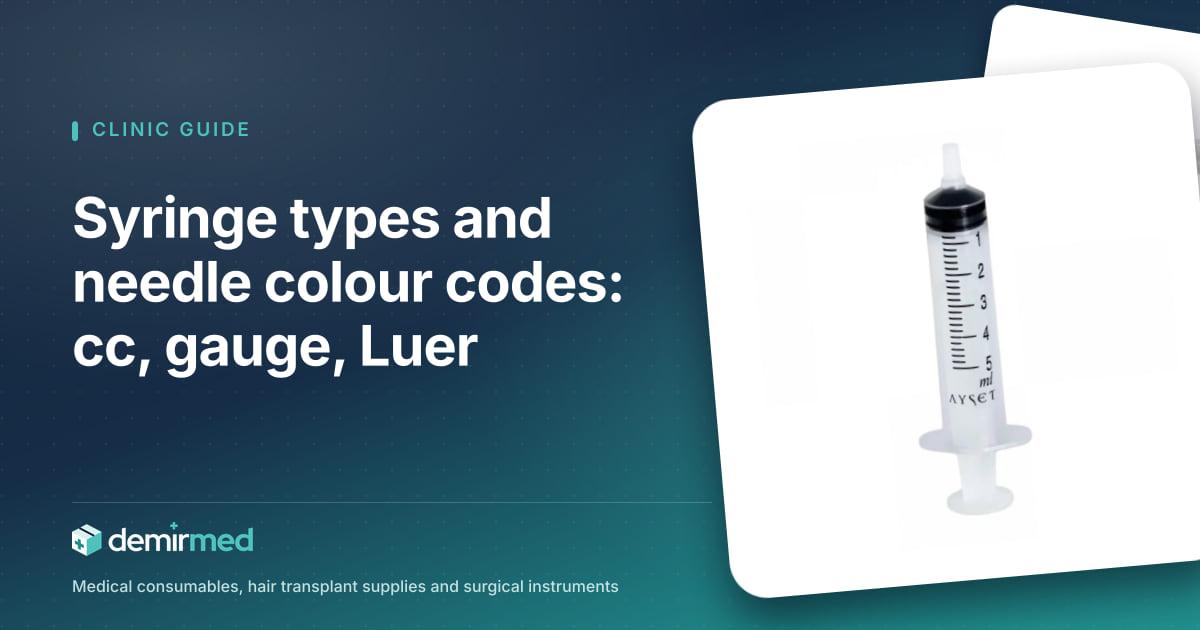
Syringe types differ in three ways: volume (1 cc, 2–2.5 cc, 5 cc, 10 cc and larger), tip (Luer-Slip, where the needle is pushed on, and Luer-Lock, where it is twisted and locked) and field of use (general syringes, dental syringes, insulin pen needles and so on). Needle colour codes show the thickness of the needle, its gauge (G): the colour of the plastic hub follows an international code, for example 21G is green, 23G blue, 25G orange and 30G yellow. The higher the gauge number, the finer the needle. The Syringes and Needles category at Demir Med holds 1, 2.5, 5 and 10 cc Luer-Slip syringes, 2 and 10 cc Luer-Lock syringes, a 30 G 13 mm needle, a 40 mm dental needle and an insulin pen needle. Which volume and which needle is used for which procedure is the physician's decision; this guide covers the types, the colour code, compatibility and purchasing.
Syringe types: which volume is used for what?
The cc figure on a syringe is its volume; 1 cc equals 1 ml. The smaller the syringe, the finer the scale on the barrel and the more exactly small amounts can be read; the larger it is, the more liquid it draws in one go. A syringe is therefore chosen in the volume closest to the amount to be drawn: reading 0.3 ml on a 10 cc syringe is guesswork.
| Volume | Typical scale steps | Common use in a clinic | Product in the catalogue |
|---|---|---|---|
| 1 cc (1 ml) | 0.01–0.1 ml | Small doses, intradermal and subcutaneous use, vaccine preparation | 1 cc Syringe |
| 2–2.5 cc | 0.1 ml | Local anaesthesia, dentistry, small intramuscular volumes | 2-2.5 cc Syringe |
| 5 cc | 0.2 ml | General injections, solution preparation, aspiration | 5 cc Syringe |
| 10 cc | 0.2–0.5 ml | Reconstitution, irrigation, aspiration, line flushing | 10 cc Syringe |
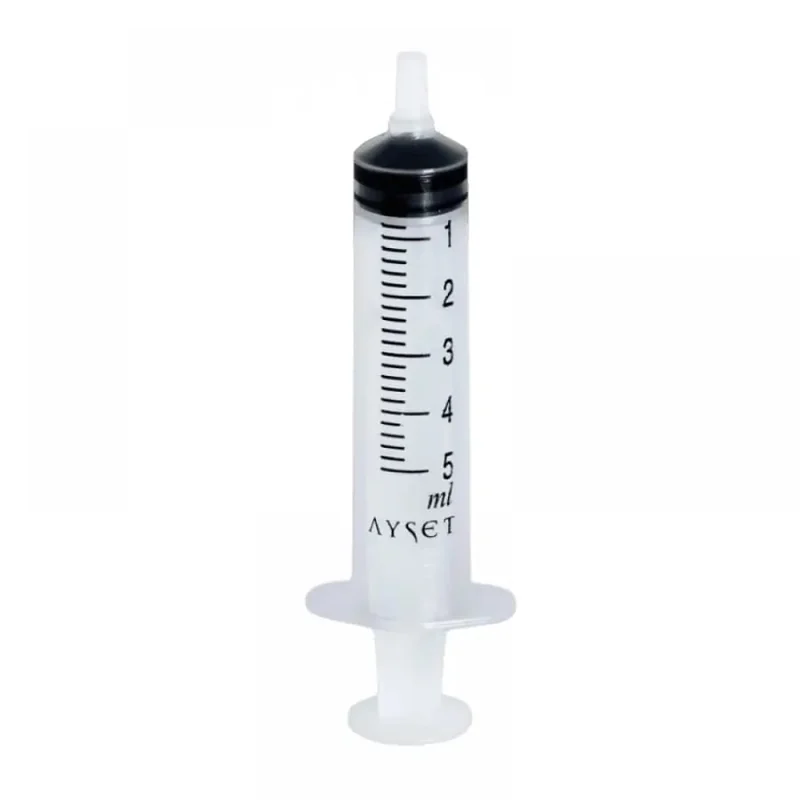
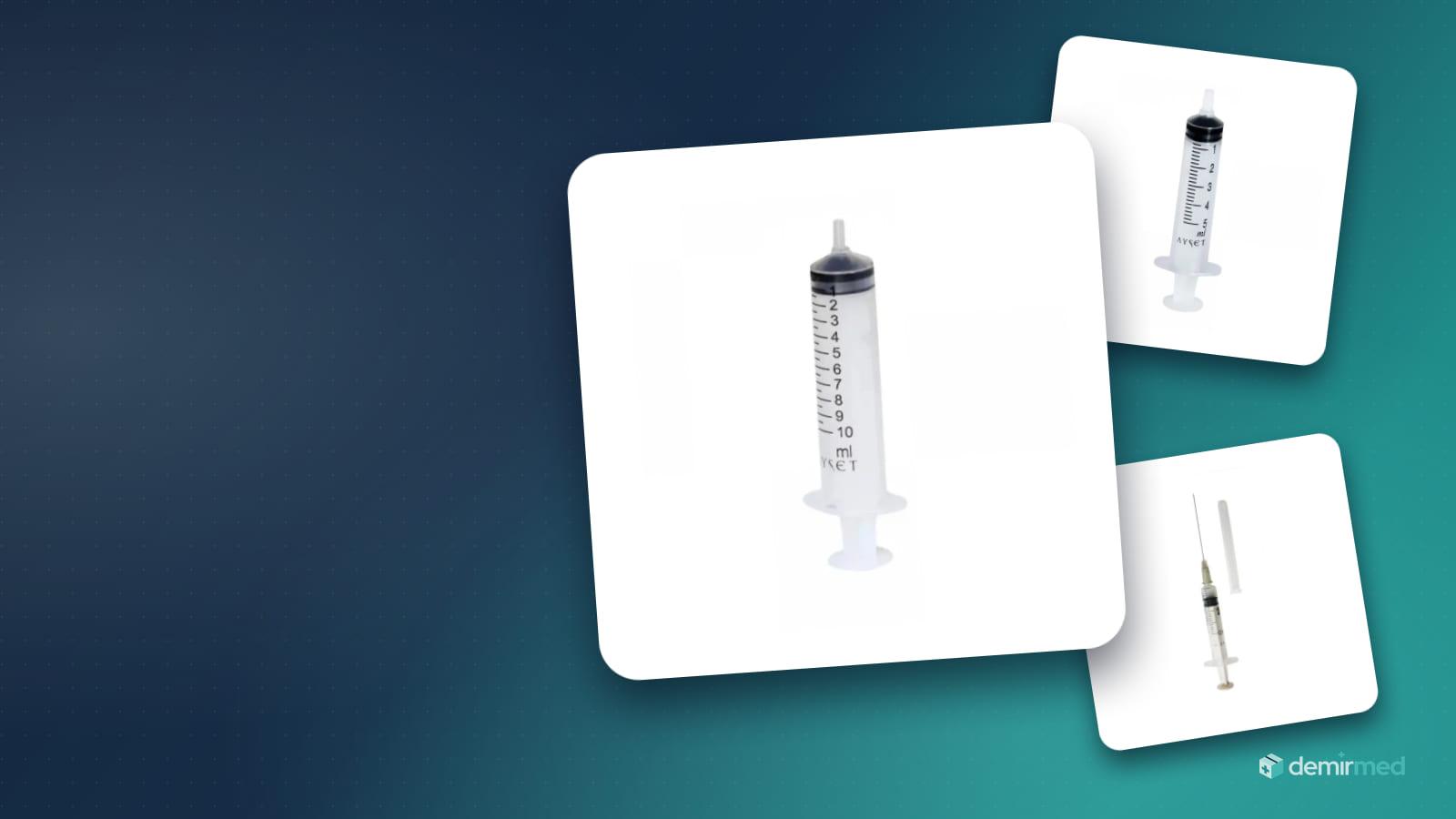
The 1, 2.5, 5 and 10 cc syringes in the catalogue are sterile, single-use and individually packed; the scale is printed on the barrel and they are sold in boxes of 100. Volumes of 20 cc and above, and catheter-tip syringes used for feeding and irrigation, are separate product groups; state the need in your quote request.
Two-part and three-part syringes
A syringe body has two or three parts. A three-part syringe has a rubber stopper on the plunger; the plunger glides smoothly and seals well. A two-part syringe has no stopper, the plunger sits directly in the barrel; it is preferred where contact with latex or silicone oil is unwanted. Which one is used depends on the procedure and the institution's protocol. If the product page does not state the number of parts, ask in the quote request.
How to read the scale
The scale is read at the upper ring of the stopper where it touches the barrel, not at the pointed tip of the stopper or its lower ring. Hold the syringe at eye level with the needle pointing up; tap the barrel so air bubbles rise, then push the plunger to expel them. In every syringe some liquid stays in the tip and inside the needle when the plunger is fully pushed in; this is the dead space. It matters with small doses, which is one reason small amounts are drawn with small syringes. The value of one graduation differs from syringe to syringe: on a 1 cc syringe one step may be 0.01 ml, on a 10 cc syringe 0.2 or 0.5 ml. Checking the graduation on the box or the barrel when you change brand or volume is the simplest safeguard against a dosing error.
Volume
1, 2.5, 5 and 10 cc: which volume for what
Syringe tips: Luer-Slip or Luer-Lock?
The conical tip that takes the needle is called a Luer, and it comes in two forms.
- Luer-Slip: the needle is pushed onto the cone and pulled off. It is quick and common for routine injections and solution preparation. The 1, 2.5, 5 and 10 cc syringes in the catalogue are of this type.
- Luer-Lock: a threaded collar surrounds the tip; the needle or line is twisted on and locked. It keeps the needle from being pushed off under high plunger pressure, and is preferred with fine needles (27G and finer), viscous liquids, three-way stopcocks and extension lines.
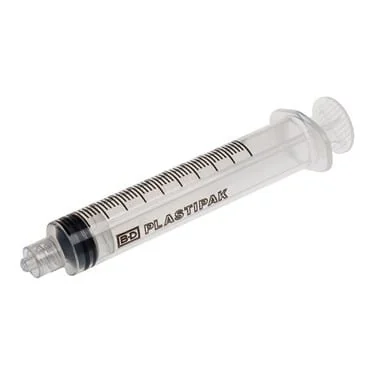
The locking types in the catalogue are the 10 cc Luer-Lock Syringe and two 2 cc Luer-Lock syringes. Standard Luer needles fit both tips; the difference is how the needle is held in place. Why a locking tip is preferred for mesotherapy and other fine-needle work is explained in the hair mesotherapy supplies guide.
Needle colour codes and gauge numbers
The colour of a needle's plastic hub is not decoration: it is the international colour code for the outer diameter of the needle (ISO 6009). The same gauge carries the same colour whoever makes it, so a needle on the tray can be told apart without reading its pack. The table lists the sizes met most often in a clinic.
| Gauge | Outer diameter (approx.) | Colour | Common use in a clinic |
|---|---|---|---|
| 18G | 1.2 mm | Pink | Drawing up from a vial, reconstitution |
| 19G | 1.1 mm | Cream | Drawing up, viscous liquids |
| 20G | 0.9 mm | Yellow | Drawing up, blood collection |
| 21G | 0.8 mm | Green | Blood collection, intramuscular use |
| 22G | 0.7 mm | Black | Intramuscular use |
| 23G | 0.6 mm | Blue | Intramuscular and subcutaneous use |
| 25G | 0.5 mm | Orange | Subcutaneous use |
| 26G | 0.45 mm | Brown | Subcutaneous and intradermal use |
| 27G | 0.4 mm | Grey | Local anaesthesia, intradermal use |
| 30G | 0.3 mm | Yellow | Mesotherapy, local anaesthesia, fine intradermal work |
20G and 30G are both yellow; the difference is plain to the eye, and the G value on the pack removes any doubt. Shades vary between manufacturers; what counts is always the gauge and the length in mm on the pack label. The uses in the table are general information; which needle is used for which procedure is decided by the physician and the institution's protocol.
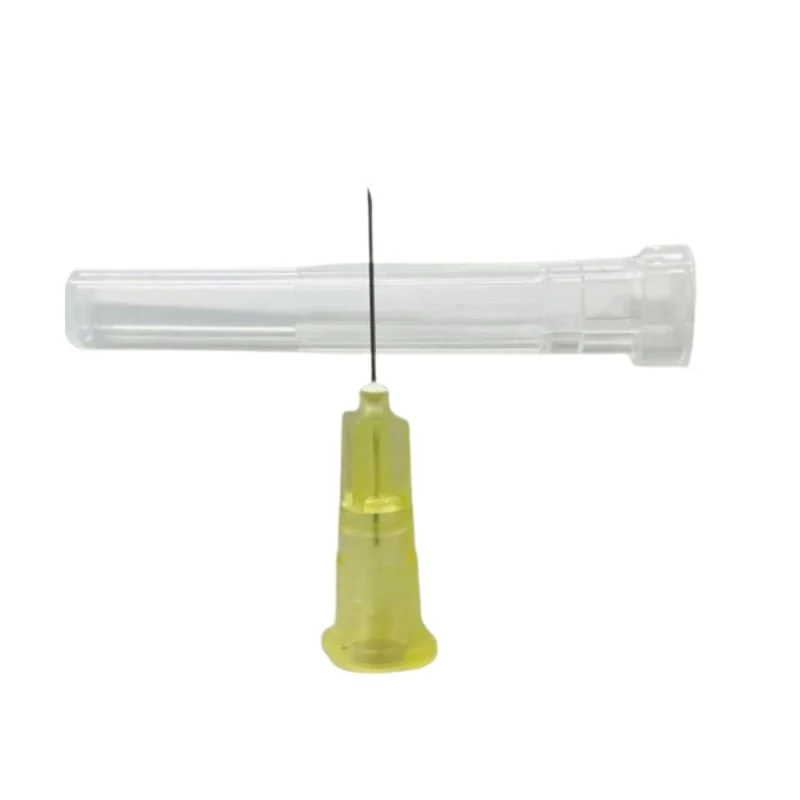
Why does a higher gauge mean a finer needle?
Gauge comes from an old wire measure: the number tells how many times a wire of a given weight was drawn thinner. So the diameter falls as the number rises: 18G is thick, 30G is fine. A fine needle leaves a smaller mark, but pushing the same liquid through it takes more force on the plunger and the flow is slower. Forcing a viscous liquid through a fine needle can push the needle off a Luer-Slip tip; that is what the locking tip is for.
Needle length: mm and inches
Next to the gauge the pack states the length: "30 G 13 mm" or "21G × 1½ inch". One inch is 25.4 mm; ½ inch is about 13 mm, 1 inch 25 mm and 1½ inch 38–40 mm. Length is chosen for the depth the procedure aims at, and the same gauge is made in several lengths. The 30 G 13 mm Needle in the catalogue carries both figures in its name: G is the thickness, mm the length.
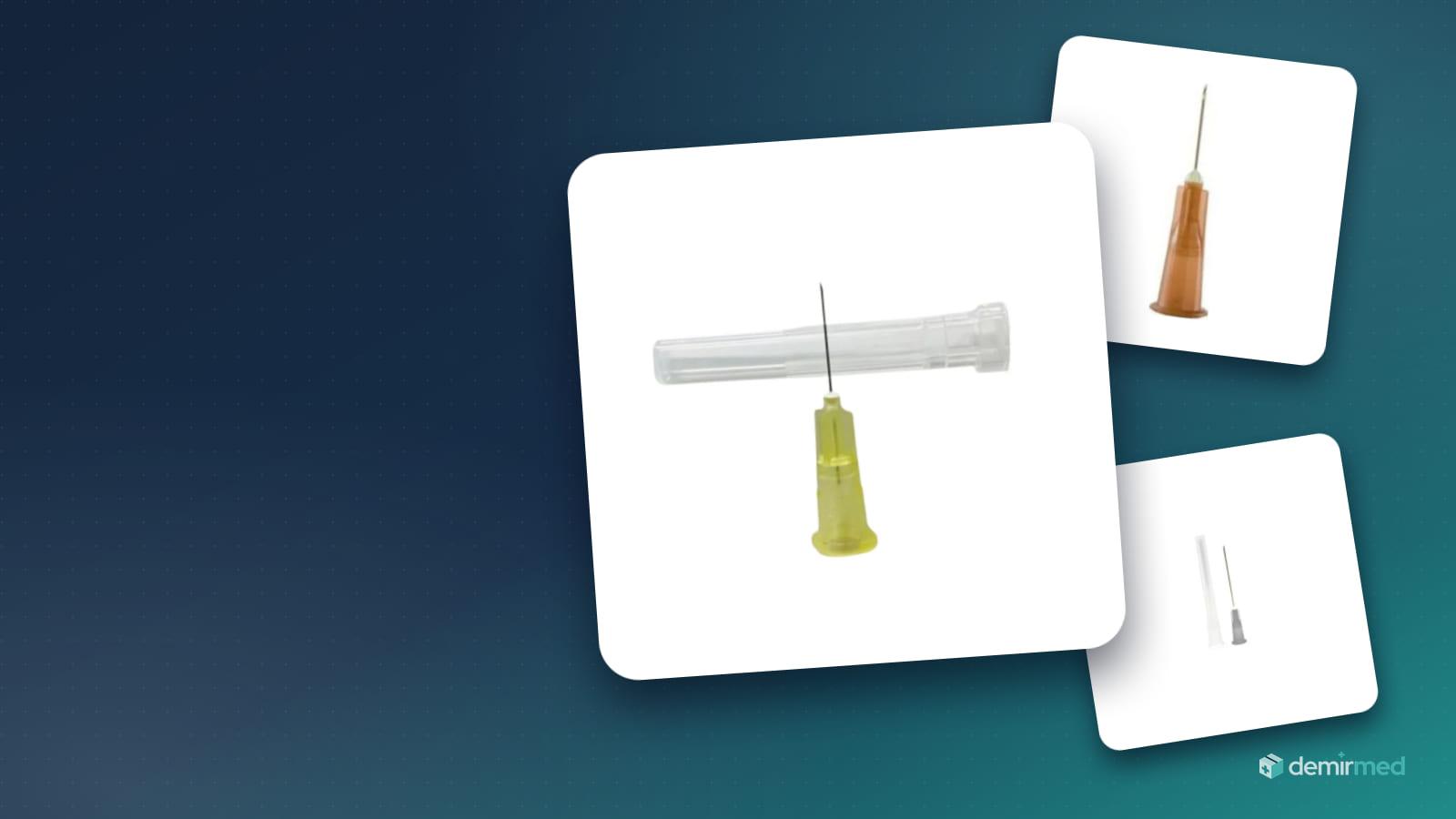
Colour code
The higher the gauge, the finer the needle
Which needle fits which syringe?
Not every needle fits every syringe. The most common ordering mistake is taking an insulin pen needle for a syringe needle.
| Needle type | Connection | Where it fits | Product in the catalogue |
|---|---|---|---|
| Standard injection needle | Luer (cone) | Luer-Slip and Luer-Lock syringes | 30 G 13 mm Needle |
| Dental needle | Dental syringe connection | Dental (cartridge) syringe | Dental Needle 40 mm |
| Insulin pen needle | Screw-on | Insulin pens; does not fit a syringe | Insulin Needle (Brown) |
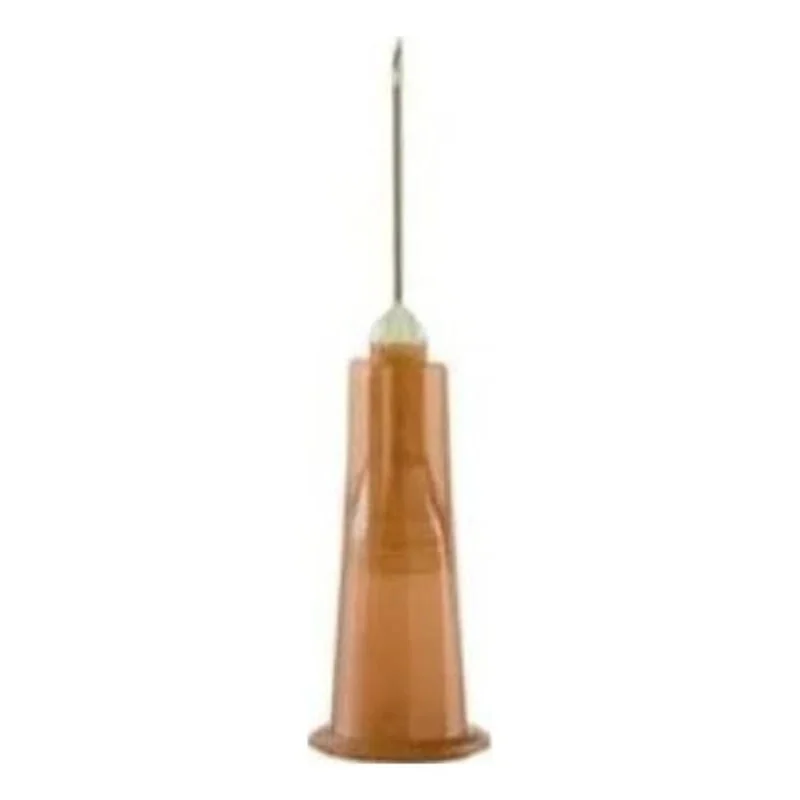
Length and gauge of insulin pen needles are a subject of their own, covered in the insulin pen needle guide. Cannulas placed in a vein are not needles either; their colour code is different and is explained in IV cannula colours and sizes.
Why are draw-up and injection needles kept separate?
A needle that has passed through the rubber stopper of a vial is blunted. Many protocols therefore draw the liquid with a thick needle (18G–21G) and inject with a new, fine one: the liquid is drawn quickly and a sharp tip enters the skin. In hair transplant and aesthetic clinics this is daily routine: local anaesthesia and mesotherapy with a fine needle, solution preparation with a thick one. When planning quantities, count at least two needles per procedure (one to draw up, one to inject). Which needle is used is the physician's decision.
Syringes and needles in a hair transplant or aesthetic clinic
In hair transplant and aesthetic work, syringes and needles are the most consumed items of the procedure day. The table shows which volume and which needle range usually goes on the tray for which job in these clinics; the exact choice is the physician's protocol.
| Job | Syringe | Needle (general range) | Note |
|---|---|---|---|
| Solution preparation and reconstitution | 5–10 cc | 18G–21G draw-up needle | A new needle for every vial |
| Local anaesthesia | 1–5 cc, preferably locking | 27G–30G | Needle renewed in long sessions |
| Hair mesotherapy and PRP application | 1–2.5 cc, locking | 30G–32G | Details in the mesotherapy guide |
| Rinsing and irrigation | 10 cc and larger | No needle or a blunt tip | Never mixed up with injection needles |
The full procedure-day list is in the hair transplant minimum supply list. The punches, sapphire blades and DHI needles used for extraction and channel opening are not injection needles; they are separate product groups on the hair transplant supplies page.
Common ordering mistakes
- Writing only the cc: "5 cc syringe" does not say the tip; state Luer-Slip or Luer-Lock.
- Naming only the colour: a "yellow needle" may be 20G or 30G; write gauge and mm together.
- Mixing syringes with and without a needle: some syringes are packed with a needle, some without; check on the product page whether needles are needed as a separate line.
- Taking a pen needle for a syringe needle: an insulin pen needle does not fit a Luer tip.
- Confusing box and piece: some lines are sold per box, some per piece; the selling unit is a separate line on the quotation.
Safe use: single use and sharps disposal
- Syringes and needles are single-use: one patient, one procedure. A product whose pack has been opened is no longer sterile, used or not.
- Do not use a product whose pack is torn or wet, or which is past its expiry date.
- A used needle is not recapped by hand; needle and syringe go into the sharps container together, without being separated.
- The sharps container stands within reach of the working area and is closed and replaced when three quarters full.
- Lot number and expiry date are on the box; store on a first-in, first-out basis.
Storage and shelving of sterile consumables are covered in the sterile medical consumables guide.
Quantity planning: how many boxes of syringes and needles?
Consumption follows the number of procedures. A simple method: for one week note how many syringes and needles each kind of procedure uses, multiply by the monthly number of procedures and add a week of safety stock.
| Item | Per procedure (example) | Pack | Note |
|---|---|---|---|
| Syringe (volume to suit the procedure) | 1–2 | Box of 100 | 2 where preparation and injection use separate syringes |
| Draw-up needle (18G–21G) | 1 | Box | A new needle for every vial |
| Injection needle | 1–3 | Box | Replaced when blunted in long sessions |
| Sharps container | — | Piece | Replaced at the fill line |
Example: an outpatient clinic doing 20 procedures a day with one syringe and two needles each uses about 440 syringes and 880 needles a month (22 working days); with the weekly reserve that is 6 boxes of syringes. The figures only show the method; replace them with your own count.
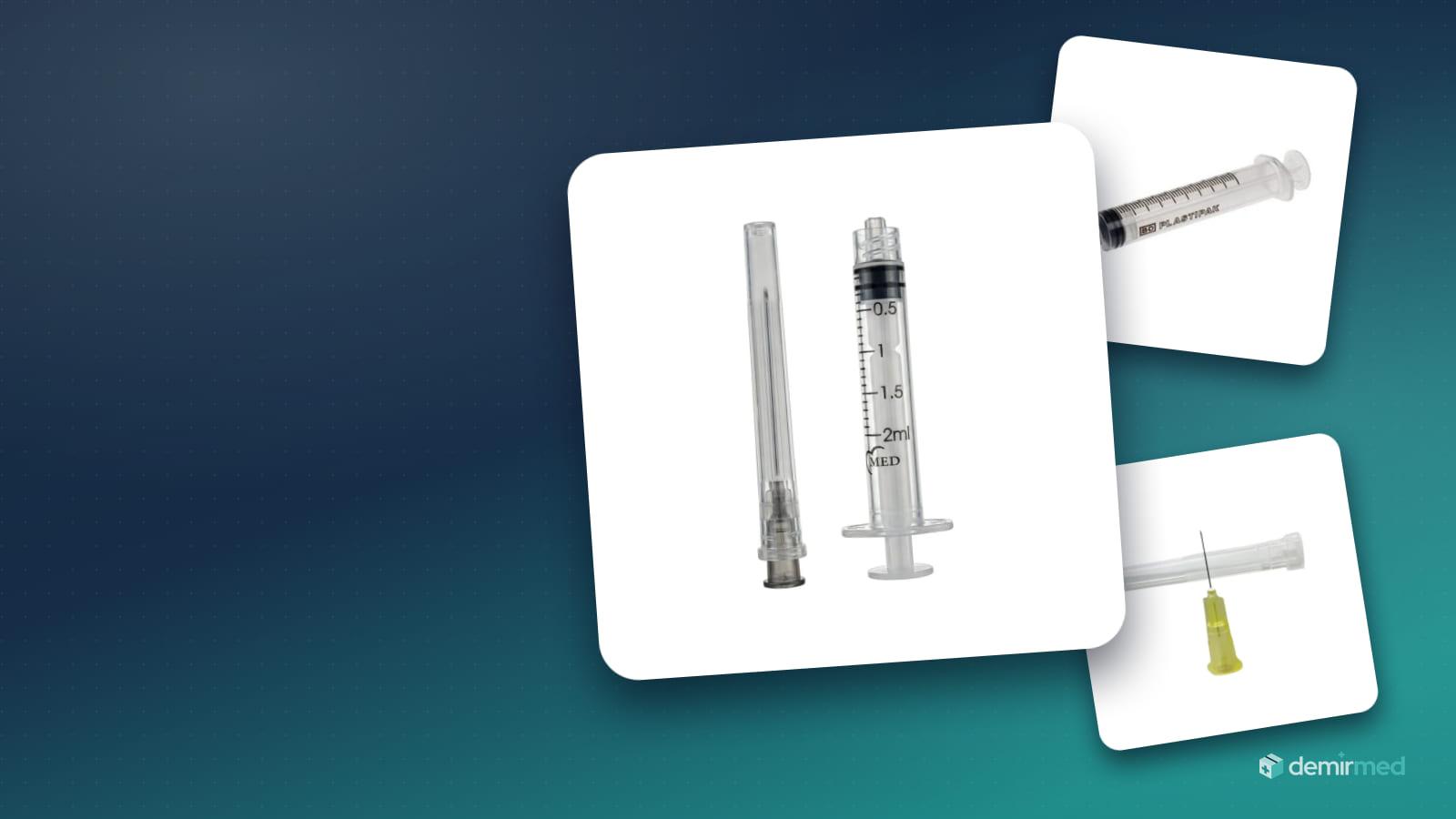
Quantity plan
Procedures × quantity + one week of reserve
Purchasing checklist
- Volumes decided: which of 1, 2.5, 5 and 10 cc, and how many boxes a month?
- Tip decided: Luer-Slip or Luer-Lock; locking type added for fine-needle procedures?
- Needles written as gauge and mm (for example 30 G 13 mm); draw-up needles listed separately?
- Insulin pen needles not confused with syringe needles.
- Dental syringe and dental needle added as separate lines where dental work is done.
- Selling unit checked: box or piece; is the box quantity on the product page?
- Sharps container, gloves and alcohol swabs added to the same request.
- Delivery address and any regular shipment wish stated in the quote request.
Products
All syringes and needles are in the Syringes and Needles category; for institutional buying the wholesale syringes and needles page shows the current list with selling units. For vascular access products such as infusion sets and cannulas see IV set versus infusion set. Add products and quantities to your list and request a quote; the quotation is sent as a PDF within 1 business day.