Short answer
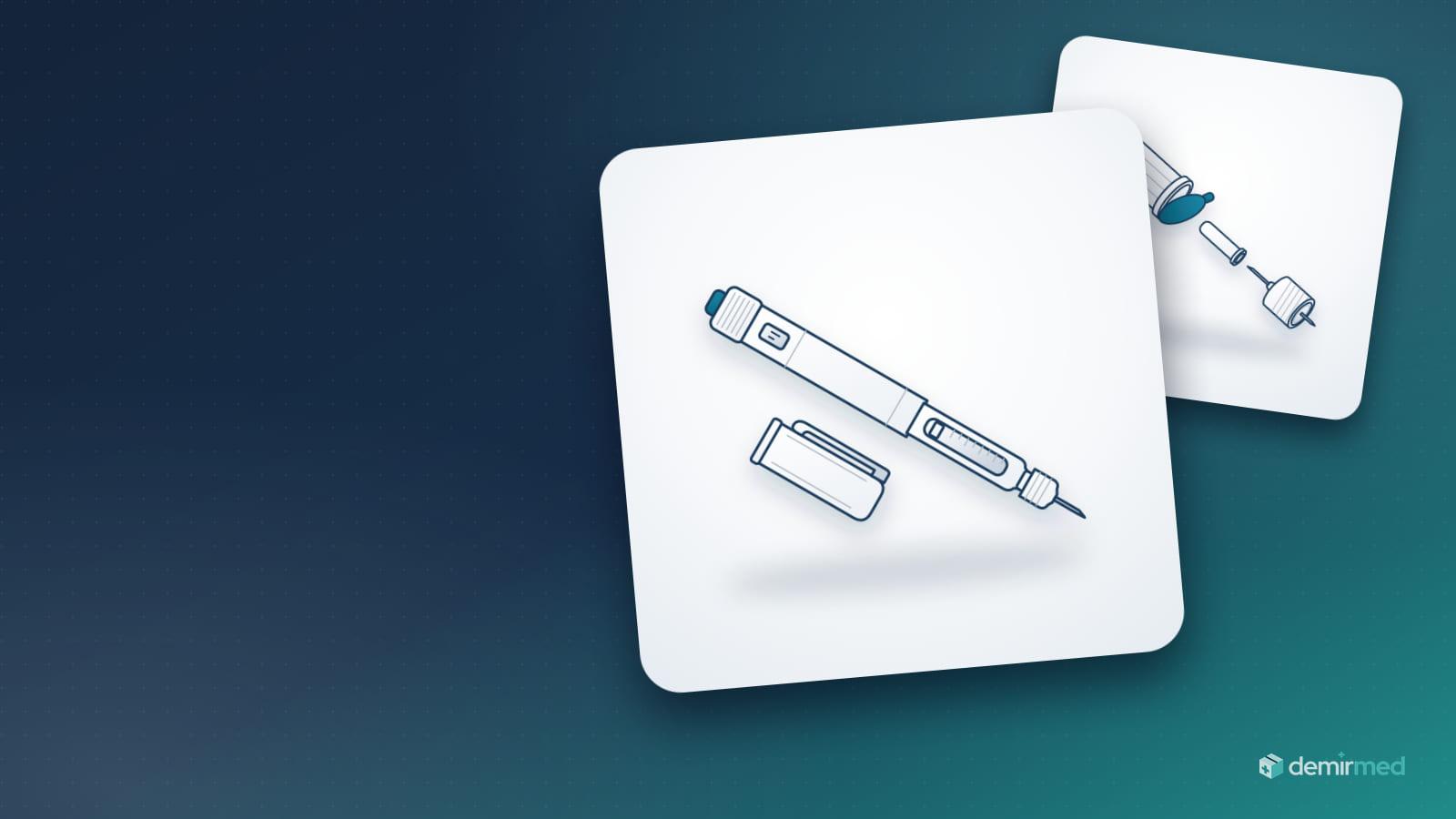
An insulin pen needle is a sterile, single-use, double-ended needle that screws onto an insulin pen. Under the current FITTER recommendations, the first choice for most adults and children is a 4 mm needle inserted at 90°, usually without a skin fold; young children and very lean adults may need a lifted skin fold. Pen needles are described by length (4–8 mm) and gauge (29G–34G), and a new one is used for every injection.
What is an insulin pen needle? Parts and compatibility
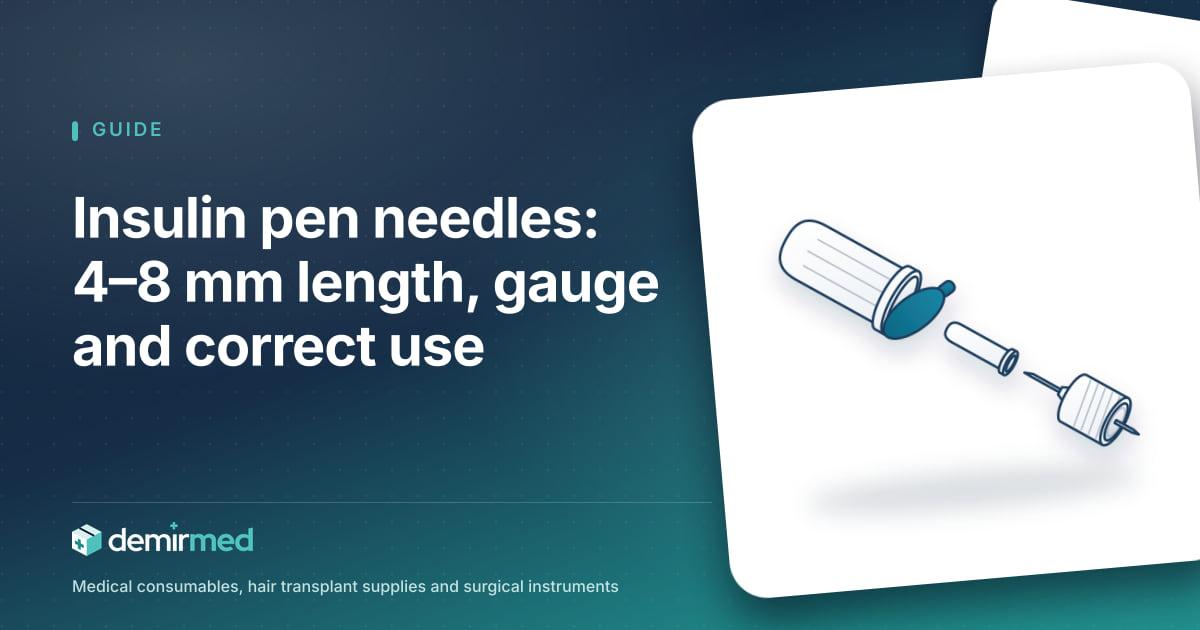
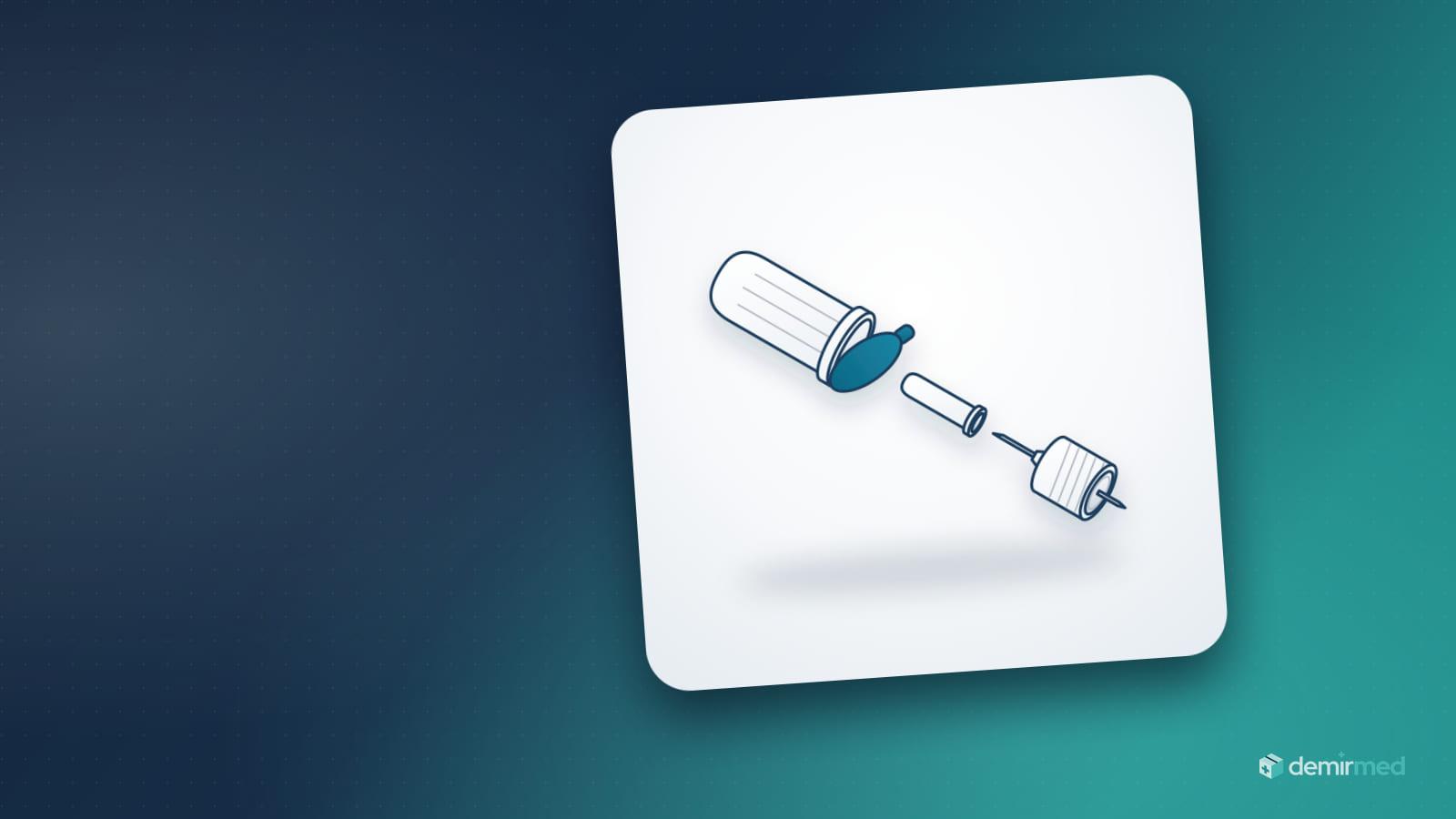
A pen needle is the consumable part fitted to the tip of a cartridge-based or prefilled (disposable) insulin pen. When patients talk about their "insulin needle", they usually mean this part: the pen holds the insulin and the dosing mechanism, while the needle is replaced at every injection. A pen needle has five parts:
- Hub: a plastic body with an internal thread that screws onto the tip of the pen.
- Double-ended needle (cannula): the back end pierces the pen cartridge's rubber septum and the front end enters the skin. The stainless steel tube is usually lubricated with silicone, and the tip has a multi-bevel grind for easier penetration.
- Inner needle shield (inner cap): a small cap over the front of the needle. It is removed just before injection and never replaced.
- Outer cap: the larger cap around the hub and needle. It is used to hold the needle while attaching it to the pen and to unscrew the needle after use.
- Peel-off seal: the paper tab that closes the outer cap and acts as the sterile barrier. A needle with a torn or opened seal is not used.
Compatibility: ISO 11608 and the pen instructions
Requirements and test methods for pen injectors and double-ended pen needles are set out in the ISO 11608 series: ISO 11608-1 covers pen injectors and ISO 11608-2 covers double-ended pen needles. Thanks to this common framework, most pen needles fit most of the common insulin pens that use the standard threaded connection. The final word, however, belongs to the pen manufacturer's instructions for use (IFU); some pens recommend specific needle types. When a new needle enters an institution's stock, it is good practice to test it on the pens used on the ward and check that it seats straight and firmly. A pen needle does not fit a syringe tip, and Luer hypodermic needles do not fit a pen.
Insulin pen, insulin syringe and insulin pump at a glance
| Feature | Insulin pen + pen needle | Insulin syringe | Insulin pump |
|---|---|---|---|
| Insulin source | Cartridge in the pen (prefilled or replaceable) | Drawn from a vial | Pump reservoir |
| Dose setting | Dial-up dose selector; mostly 1-unit steps, 0.5-unit steps on some pens | Read in units on the syringe scale | Programmed basal and bolus doses |
| Needle | 4–8 mm pen needle replaced at every injection | Usually a fixed 6–12.7 mm needle | Infusion set cannula placed under the skin; change interval set by the maker (often 2–3 days) |
| Strength | Portable, easy dose setting, wide choice of short needles | Uses vials; mixing of suitable preparations on medical advice | Continuous, flexible basal infusion |
| Watch point | A pen belongs to one patient and is never shared | A syringe matched to the insulin concentration (U-100) is essential | Needs thorough training, set changes and technical follow-up |
Insulin needle lengths: who is 4, 5, 6 or 8 mm for?
The aim is to deliver insulin into the subcutaneous fat layer. If the needle is too long or inserted at the wrong angle, insulin may reach muscle (intramuscular injection). Insulin injected into muscle is absorbed faster and less predictably and can cause unexpected hypoglycaemia and glucose swings. In adults, skin thickness (epidermis plus dermis) at injection sites averages about 2 mm, rarely exceeds 3 mm and changes very little with body mass index. Subcutaneous fat thickness, by contrast, varies widely between people and between sites. A 4 mm needle is therefore long enough to pass through the skin into the subcutaneous layer, with the lowest chance of reaching muscle.
The FITTER recommendations (Forum for Injection Technique and Therapy: Expert Recommendations; Frid et al.), developed at a 2015 meeting in Rome and published in Mayo Clinic Proceedings in 2016, sum this up as follows:
- The 4 mm pen needle is safe and effective for adults and children regardless of body mass index; it is inserted at 90°, in most people without a skin fold.
- Children aged 6 and under and very lean adults may need a skin fold (skin gently lifted between two fingers) even with a 4 mm needle.
- With needles of 6 mm or longer, a skin fold or a 45° angle is advised to avoid intramuscular injection, especially in children and lean adults.
| Length | Typical use | Technique note (general) |
|---|---|---|
| 4 mm | First choice for adults and children, including people with obesity | 90°; skin fold usually not needed, but used in young children and very lean adults |
| 5 mm | Close to 4 mm; available in some needle ranges | 90°; consider a skin fold in lean patients |
| 6 mm | Patients who have used this length for years; the shortest common length on insulin syringes | Skin fold or 45° in children and lean adults |
| 8 mm | Legacy habit; not a first choice in current recommendations | Clear risk of intramuscular injection; skin fold and/or 45° advised |
| 10–12.7 mm | Legacy lengths; still found on some syringes | High risk of intramuscular injection; not recommended for new patients |
The table shows the general picture; product ranges vary by manufacturer. The choice for an individual patient rests with the physician's and diabetes nurse's assessment and local protocol.
Switching from longer needles to 4 mm
Moving a patient from an 8 mm or longer needle to 4 mm is a common change to reduce the risk of intramuscular injection and the glucose swings that follow. Studies have shown that glucose control with 4 mm needles is similar to that with longer needles, even in patients with obesity; a short needle does not reduce the effect of insulin. During the switch the patient's technique is reviewed, site rotation and lipohypertrophy are checked, and glucose monitoring is stepped up if needed.
Anatomy
Parts of a pen needle
Insulin pen needle gauge table: from 29G to 34G
Gauge (G) is the unit that expresses a needle's outer diameter, and the higher the number, the thinner the needle. The same system is used for IV cannulas; for colour and size equivalents see our IV cannula colours and sizes guide. Pen needles range from 29G to 34G. Thinner needles reduce the sensation of the needle entering the skin and make it easier for patients to stay with their treatment.
| Gauge | Approximate outer diameter | General character | Lengths it is commonly paired with on the market |
|---|---|---|---|
| 29G | ~0.33 mm | Thickest group of pen needles; common on older, longer needles | 10–12.7 mm |
| 30G | ~0.30 mm | Medium | 8 mm |
| 31G | ~0.25–0.26 mm | Fine; widely used | 5, 6, 8 mm |
| 32G | ~0.23 mm | Very fine; a frequent choice for short needles | 4, 5, 6 mm |
| 33G | ~0.20 mm | Extra fine | 4, 5 mm |
| 34G | ~0.18 mm | Among the finest pen needles on the market | 4 mm |
Diameters are approximate values close to the nominal sizes in ISO 9626; length and gauge pairings vary by manufacturer.
What do thin wall and extra thin wall add?
- For the same outer diameter, a thinner wall gives a wider inner bore (lumen). Thin wall (TW) and extra thin wall (XTW) needles therefore let insulin flow with less resistance.
- In practice, less thumb force is needed on the button and injection becomes easier, especially for larger doses. Patients with arthritis and older patients notice the difference clearly.
- Flow resistance rises with gauge; an extra thin wall largely offsets this. A thin needle still needs the full hold time stated in the pen instructions.
- Tip grind and silicone coating also shape comfort; a needle starts to lose these properties after its first use.
How is an insulin pen needle used? Principles of correct injection technique
The principles below are the general framework that healthcare professionals teach patients, in line with pen instructions and the FITTER recommendations. Details such as the priming dose, hold time and resuspension of cloudy insulin can differ between pen models; dosing and treatment decisions rest with the physician.
- A new needle every time: peel off the seal of the sterile pack, screw the needle straight onto the pen, then remove first the outer cap and then the inner shield. Keep the outer cap, because it is used to remove the needle afterwards.
- Check the pen and the insulin: check the label (correct insulin), expiry date and appearance. Cloudy insulins (NPH or premixed) are resuspended as the instructions describe, by rolling and tipping the pen.
- Air shot (prime): dial usually 2 units, hold the pen with the needle pointing up, tap the cartridge gently so air bubbles rise, and press the button. A drop of insulin should appear at the needle tip. If not, repeat as many times as the instructions allow; if there is still no drop, change the needle. This step confirms that the needle is open and the pen works correctly.
- Set the dose: dial the dose prescribed by the physician.
- Insert at 90°: with a 4 mm needle, go in perpendicular to the skin. If a skin fold is needed, keep it lifted throughout the injection and release it after the needle is out. Do not inject through clothing; skin antisepsis follows institutional protocol, and if alcohol is used, let the skin dry.
- Press the button fully: press with the thumb until the dose display returns to zero.
- Hold for about 10 seconds: keeping the button pressed, leave the needle in the skin for the time stated in the pen instructions (10 seconds for most pens). Withdrawing early can let part of the dose leak onto the skin surface.
- Withdraw and dispose: withdraw at the same angle, put the outer cap back on to unscrew the needle from the pen, and drop it straight into a sharps container. Store the pen without a needle, with its own cap on.
One pen, one patient: even with a new needle, an insulin pen is never shared between patients. Blood can flow back into the cartridge and create a risk of blood-borne infection.
Injection sites and rotation
- Sites: the abdomen (avoiding the area immediately around the navel), the upper front-outer thigh, the upper outer buttock and the back-outer surface of the upper arm.
- Absorption differences: absorption is faster in the abdomen and slower in the thigh and buttock, particularly with human insulins. Which insulin goes to which site is set by the physician's and diabetes nurse's plan.
- Systematic rotation: divide the abdomen into four sections and the thighs, buttocks and arms into two each; use one section for a week and move clockwise. Within a section, space each injection at least about 1 cm (one finger's width) from the previous one.
- Areas to avoid: do not inject into skin that is painful, bruised, red, hardened, wounded or scarred.
Lipohypertrophy: recognition and prevention
Lipohypertrophy is a rubbery, thickened area of subcutaneous fat that develops after repeated injections into the same place. Because injecting there hurts less, patients tend to keep choosing the same spot. Insulin absorption from such areas is delayed and erratic, however, and unexplained glucose swings and hypoglycaemia can follow.
- Main causes: no site rotation, frequent injections into a small area and needle reuse.
- Checking: the healthcare professional inspects and palpates the injection sites with the fingertips at every visit, and patients are taught to check their own sites regularly.
- Prevention: systematic rotation, use of a wide area and a new needle for every injection.
- Moving from a lipohypertrophic area to healthy tissue can increase absorption, so dose requirements may change. The move is made with closer glucose monitoring and under the physician's guidance.
Sizing
Length and gauge: 4 mm at 90° comes first
Why are insulin needles single use? The risks of reusing pen needles
Pen needles are single use; the pack usually carries the single-use symbol (a crossed-out 2). Even so, using the same needle for days is a common habit in practice. A needle may look intact, but after the first injection the following changes begin:
- Tip bending and blunting: the tip curls at a microscopic level (forming a "hook") and goes blunt, increasing pain, tissue trauma, bleeding and bruising.
- Loss of lubricant: the silicone coating wears off with every insertion, so more force is needed to pierce the skin and discomfort increases.
- Blockage: insulin drying and crystallising inside the needle can obstruct flow, causing an incomplete dose or a stiff button.
- Contamination: a non-sterile needle can carry micro-organisms into the skin.
- Air entry into the cartridge and leakage: a needle left on the pen forms an open channel between the cartridge and the outside. With temperature changes, air enters the cartridge or insulin leaks out, which undermines dose accuracy.
- Lipohypertrophy: needle reuse has been associated with lipohypertrophy.
The needle is therefore removed from the pen after every injection, and the pen is never stored with a needle attached. In institutions the needle is opened at the bedside, used once and discarded. A practical way to prevent reuse is to work out the monthly needle requirement with the patient: someone injecting 4 times a day uses about 120 needles a month.
Insulin syringes: the U-100 scale and how they differ from a 1 cc syringe
An insulin syringe is a syringe designed to draw insulin from a vial and inject it, with a scale printed in units rather than millilitres. The standard concentration of vial insulin is U-100 (100 units per ml), so U-100 insulin is given with a U-100 insulin syringe. Concentrated insulins such as U-200 and U-300 are also found in pens.
- Typical sizes: 0.3 ml (30 units), 0.5 ml (50 units) and 1 ml (100 units). A 0.3 ml syringe reads small doses more precisely, and some models have half-unit markings.
- Needle: usually a fixed (integrated) needle of 6, 8 or 12.7 mm, generally 30–31G. A fixed needle reduces dead space. Because 6 mm is the shortest common syringe needle, a skin fold is generally advised in children and lean adults.
- The concentration must match: the syringe scale and the insulin concentration must be the same. U-40 syringes for veterinary insulins are also on the market. Drawing U-100 insulin into a U-40 syringe, or the reverse, gives a dose about 2.5 times too high or too low.
- Do not draw from a pen cartridge with a syringe: drawing insulin from a pen cartridge with a syringe can cause serious dosing errors, especially with concentrated insulins; concentrated insulins are given only with their own pen.
A 1 cc syringe is not an insulin syringe
The 1 cc syringe in our catalogue is a general-purpose, sterile, single-use syringe with a Luer-Slip (push-fit) tip and a millilitre scale up to 1 ml. It accepts standard Luer needles, is individually packed and is sold in boxes of 100. It suits low-volume medication, vaccine preparation and small-volume liquid transfer. As it has no unit scale, it is not used to measure insulin doses; if insulin is to be given by syringe, a U-100 insulin syringe with a unit scale is required. For other volumes, see the syringes category.
Safety pen needles and sharps disposal
Safety pen needles for healthcare workers
In hospitals and care homes, insulin is usually given by nurses. With a standard pen needle, the outer cap has to be put back on to remove the needle from the pen, and this step is a known cause of needle-stick injuries. Safety pen needles cover the patient end after injection, and on some models the cartridge end too, with a locking shield.
- Passive system: the shield locks automatically as the needle leaves the skin; the user does not need to do anything extra.
- Active system: the user activates the shield with one hand.
- Institutional policy: choosing safety needles for staff use is part of a sharps-injury prevention programme. In the European Union, Directive 2010/32/EU calls for risk assessment, the use of devices with safety-engineered protection and a ban on recapping.
- If standard needles are used: never recap with two hands; use the one-handed scoop technique or a needle remover, and discard the needle immediately.
Where do used insulin needles go?
- Used pen needles, lancets and syringes go into a puncture-resistant sharps container with a one-way lid. The sharps container in our catalogue comes in 1.5 L (treatment trolleys, home care), 3 L (injection rooms, doctors' practices) and 5 L (high-use areas such as wards).
- Needles are never thrown loose into household waste, plastic bags or recycling bins.
- Fill the container to the fill line, or to about three quarters if there is none, without pressing the waste down. Close the full container and hand it over to an authorised collection service according to the institution's medical waste procedure. The container is not emptied or reused.
- Patients using insulin at home are also advised to use a puncture-resistant container. Where to return a full container depends on local arrangements, and this is covered in patient education.
Common errors and how to fix them
| Error | Possible consequence | Fix |
|---|---|---|
| Reusing needles | Pain, blunt tip, blockage, contamination, lipohypertrophy | A new needle every injection; work out the monthly needle need with the patient |
| Injecting into lipohypertrophy | Delayed, erratic absorption, unexplained swings, hypoglycaemia | Palpate sites at every visit; move to healthy tissue under physician guidance |
| Needle too long | Intramuscular injection, fast and variable absorption, pain | 4 mm needle at 90°; skin fold or 45° with longer needles |
| Not holding for 10 seconds | Dose loss, a drop of insulin on the skin | Hold with the button pressed for the time in the instructions (usually 10 seconds) |
| Skipping the air shot | Underdose due to air bubbles, a blocked needle going unnoticed | Prime 2 units before every injection until a drop appears |
| Leaving the needle on the pen | Air in the cartridge, leakage, dosing error | Remove the needle straight after injection |
| Syringe not matched to concentration | Dose about 2.5 times too high or too low | Only U-100 insulin syringes for U-100 insulin; never draw from a pen with a syringe |
| Sharing pens | Risk of blood-borne infection | One pen, one patient; label each pen with the patient's name |
Disposal
Used pen needles go in a sharps container
Insulin pen needle stocking checklist for clinics and pharmacies
The points below help when planning stock for a diabetes clinic, family health centre, care home or pharmacy. For a general stock-planning method, see also our guide to clinic stock management.
Sizes and quantities
- Length mix: keep 4 mm (commonly 32G) as the main stock line for new patients and ward use. Hold smaller amounts of 5–6 mm for patients who have used these lengths for a long time and whose physician has decided they should continue; stock 8 mm and longer only for specific demand.
- Gauge: standardising on one gauge per length reduces stock lines; a thin-wall option can be chosen where comfort is a priority.
- Box quantity: the pen needle in our catalogue is sold in boxes of 100, so order quantities are planned by the box.
- Consumption estimate: the monthly need is roughly daily injections × 30 × number of patients. For example, 10 patients injecting 4 times a day use about 1,200 needles a month, which is 12 boxes. Add safety stock according to lead time.
- Pen compatibility: list the pen models used in the institution and confirm compatibility whenever a new needle is purchased.
Storage and expiry
- Store needles dry, at room temperature, away from direct sunlight and in their original box; they do not need refrigeration.
- Use the nearest expiry date first (FEFO), and check the lot number and expiry date on the box label and delivery note.
- Do not use needles with a torn seal, an open cap or wet packaging. Our sterile medical supplies guide explains package-integrity checks.
- Insulin pens are handled separately as medicines: unopened pens are usually kept refrigerated at 2–8 °C, and the pen in use is stored for the time and at the temperature stated in the product information. Insulin that has been frozen is not used.
Education and safety
- Patient education material: an injection technique card, a rotation chart and information on sharps containers.
- Sharps containers: within arm's reach at every injection point and on the treatment trolley.
- For staff: a safety needle option and examination gloves.
- A patient name label on every pen and the "one pen, one patient" rule.
What to keep alongside for glucose monitoring
Insulin therapy goes hand in hand with blood glucose monitoring. Clinics, wards and home-care teams keep a portable blood glucose meter kit that reads capillary blood from a test strip; the kit includes the meter and its matching strips. Strips are model-specific, are not used with another meter, and are stored in their closed container under the conditions on the pack. After a fingertip test, a small, round, sterile plaster such as our injection plasters covers the puncture site. Interpreting readings and making dosing decisions rest with the physician.
Sourcing insulin pen needles from Demir Med
- Insulin pen needle: a sterile, single-use, individually packed pen needle with a standard threaded connection, outer cap and inner shield; 100 per box. Gauge and length are not listed as fixed variants: write the size you need (for example 4 mm 32G) and the pen model used at your institution in your quote request, and the quotation confirms the size to be supplied and the stock position in writing. You can also state a need for a safety model in the request. See the Syringes & Needles category for all items.
- 1 cc syringe: Luer-Slip, sterile, 100 per box; not an insulin syringe. Other volumes are in the Syringes category.
- Blood glucose meter kit: meter and matching strips supplied together; listed in the Diagnostics & Test Products category.
- Sharps container: 1.5 L, 3 L and 5 L, sold by the piece; other options are in the Surgical Supplies category.
- Injection plasters: sterile round plasters, 100 per box.
Add the products to your list with "Add to quote" and send a quote request; our sales team sends a quotation within 1 business day. In-stock orders confirmed before noon are delivered the same day within İstanbul and within 1–3 business days across Türkiye. For questions about sizes, pen compatibility or a monthly supply plan, reach us through the contact page.
Sources and standards
- Frid AH et al. New Insulin Delivery Recommendations. Mayo Clinic Proceedings, 2016 (FITTER: Forum for Injection Technique and Therapy: Expert Recommendations).
- ISO 11608-1: Needle-based injection systems for medical use, requirements and test methods for pen injectors.
- ISO 11608-2: Needle-based injection systems for medical use, double-ended pen needles.
- ISO 9626: Stainless steel needle tubing for the manufacture of medical devices (gauge and diameter values).
- ISO 23907-1: Sharps injury protection, single-use sharps containers.
- US FDA safety communication (2009): the risks of sharing insulin pens between patients.
- US CDC injection safety recommendations: insulin pens are for single-patient use only.
- Council Directive 2010/32/EU on the prevention of sharp injuries in the hospital and healthcare sector.
- Turkish Regulation on the Control of Medical Waste (Tıbbi Atıkların Kontrolü Yönetmeliği, 2017).
- Pen and needle manufacturers' instructions for use (IFU) and insulin product information.