Short answer
IV set (serum set) and infusion set are two names for the same product: the sterile, single-use set of spike, drip chamber, roller clamp and tubing that connects the infusion bottle or bag to the venous line. In Türkiye everyday language says "serum seti", regulations and tenders say "infüzyon seti" (IV set). The real distinction is the type, not the name: a macro set delivers 20 drops/ml and is the adult standard; a micro set delivers 60 drops/ml and is used in paediatrics and for precise doses. The set connects to the IV cannula through a luer lock; both are separate consumables.
What an IV set is and its parts
A standard infusion set consists of:
- Spike: pierces the stopper of the bottle or bag; supplied with a protective cap.
- Air vent and filter: glass bottles need an air inlet for the fluid to flow; the filter holds back particles and microorganisms. On collapsible bags the vent stays closed.
- Drip chamber: the transparent chamber where the flow rate is counted; macro and micro sets differ here.
- Tubing: 150–180 cm, kink-resistant PVC or DEHP-free tubing.
- Roller clamp: sets the drip rate and closes the line fully.
- Injection port (Y site): allows drugs to be given without opening the line; needle-free ports are now common.
- Luer lock and needle: the set end screws onto the cannula cap; needle sets carry a cannula needle at the tip.
Macro or micro set?
| Feature | Macro (standard) set | Micro (paediatric) set |
|---|---|---|
| Drop factor | 20 drops/ml (15 drops/ml with some makers) | 60 drops/ml |
| Use | Adult fluid therapy, antibiotics, routine infusion | Paediatrics, neonates, low-volume precise drugs |
| Drip chamber | Wide, needle-free chamber | Fine metal needle inside the chamber (microdrip) |
| Rate control | Roller clamp | Roller clamp; usually with an infusion pump |
| Catalogue | Standard IV set with drip chamber, box of 50 | By quotation on request |
The sterile IV set in our catalogue is a 20 drops/ml macro set; paediatric micro sets and pump sets are added to a quotation on request.

Parts of the set
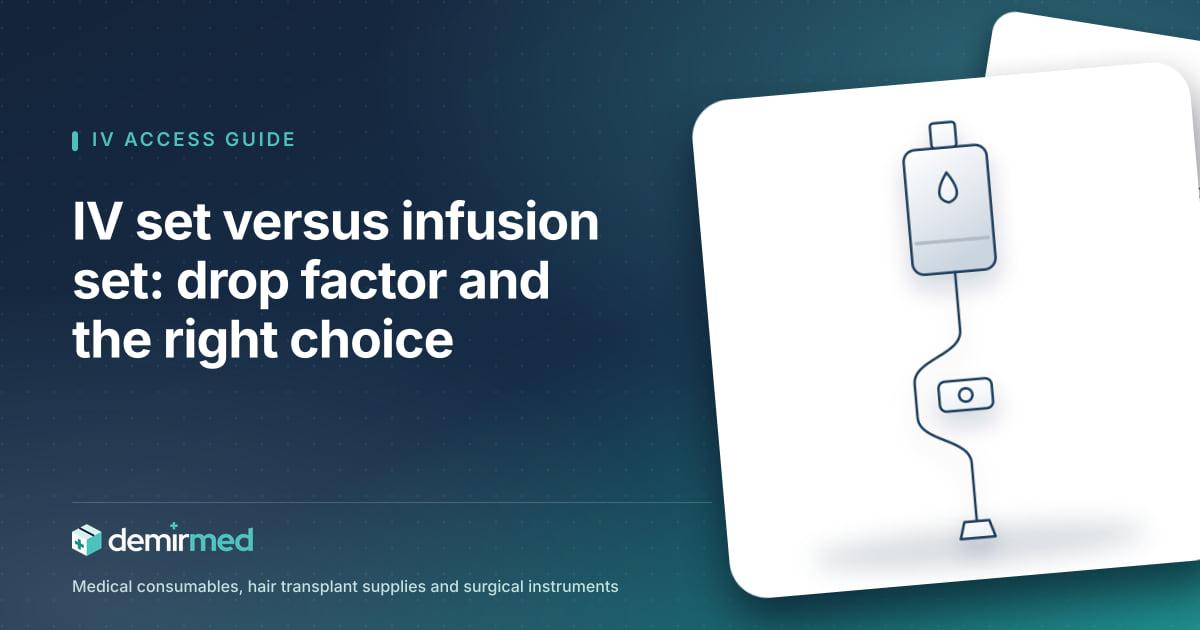
Spike, air filter, drip chamber, clamp, Y site, luer
How the drip rate is calculated
Drip rate (drops/min) = total volume (ml) × drop factor (drops/ml) ÷ time (min).
- 1,000 ml over 8 hours, macro set (20 drops/ml): 1,000 × 20 ÷ 480 = 42 drops/min.
- 500 ml over 4 hours, macro set: 500 × 20 ÷ 240 = 42 drops/min.
- 100 ml of a drug over 30 minutes, micro set (60 drops/ml): 100 × 60 ÷ 30 = 200 drops/min → this rate needs a pump.
Rule of thumb: with a macro set, "ml per hour ÷ 3 ≈ drops/min". The calculation is the clinician's responsibility; always check the drop factor on the box, because 15 and 20 drops/ml sets look alike.
Fit with the IV cannula
The infusion set is not the venous access itself; the access is opened with an IV cannula (branül, intraket). The set screws onto the cannula's luer-lock cap. Cannula gauge sets the flow rate:
| Cannula | Colour | Typical use |
|---|---|---|
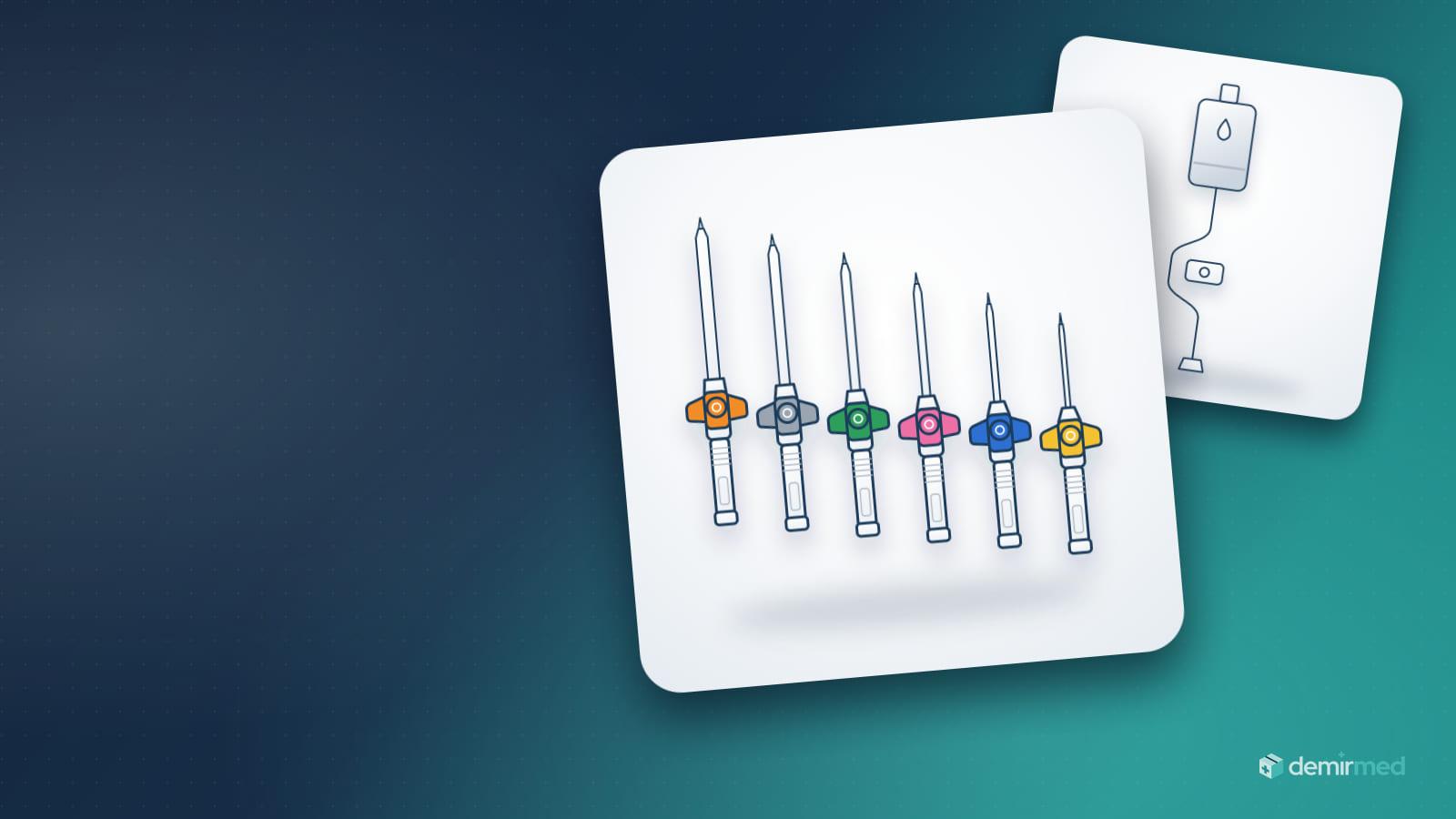
| 20G | Pink | Routine adult fluids and drugs |
| 22G | Blue | Thin veins, elderly patients, children |
| 24G | Yellow | Neonates and infants, very thin veins |
Rapid fluid resuscitation needs a larger cannula (18G green); a micro set works with thin cannulas, a macro set with any cannula. See the IV cannula colours guide for colours and sizes.
When the set is changed
For continuous infusion the set is usually changed every 72–96 hours according to institutional procedure; for blood, blood products and lipid emulsions within 24 hours. For intermittent use (a set disconnected and reconnected) the 24-hour rule applies. A new sterile set is opened at every change, the spike cap is removed only when the new bottle is attached and the inside of the set never touches anything. The cannula site follows its own dressing rule.
Cannula fit
20G pink, 22G blue, 24G yellow cannulas
Buying checklist
- Does the drop factor (20 or 60 drops/ml) match the use and is it printed on the box?
- Does the filtered vent suit glass bottles?
- Is the tubing length (150–180 cm) and DEHP-free material preferred?
- Is the Y port needle-free; does the luer-lock end fit the cannula?
- Is the set sterile, individually packed and ÜTS-registered, within expiry?
- Were cannulas (20G/22G/24G), syringes, tape and a sharps container planned in the same quotation?
- Monthly use: infusions per day × working days; planned in boxes of 50 and by the case?
Products
The IV cannulas, IV sets and infusion sets category lists the sterile IV set with drip chamber, the pink 20G IV cannula, the blue 22G cannula and the yellow 24G cannula; syringes and the sharps container are added to the same quotation. Send your monthly need through a quote request; a case-pack quotation follows within 1 business day.